
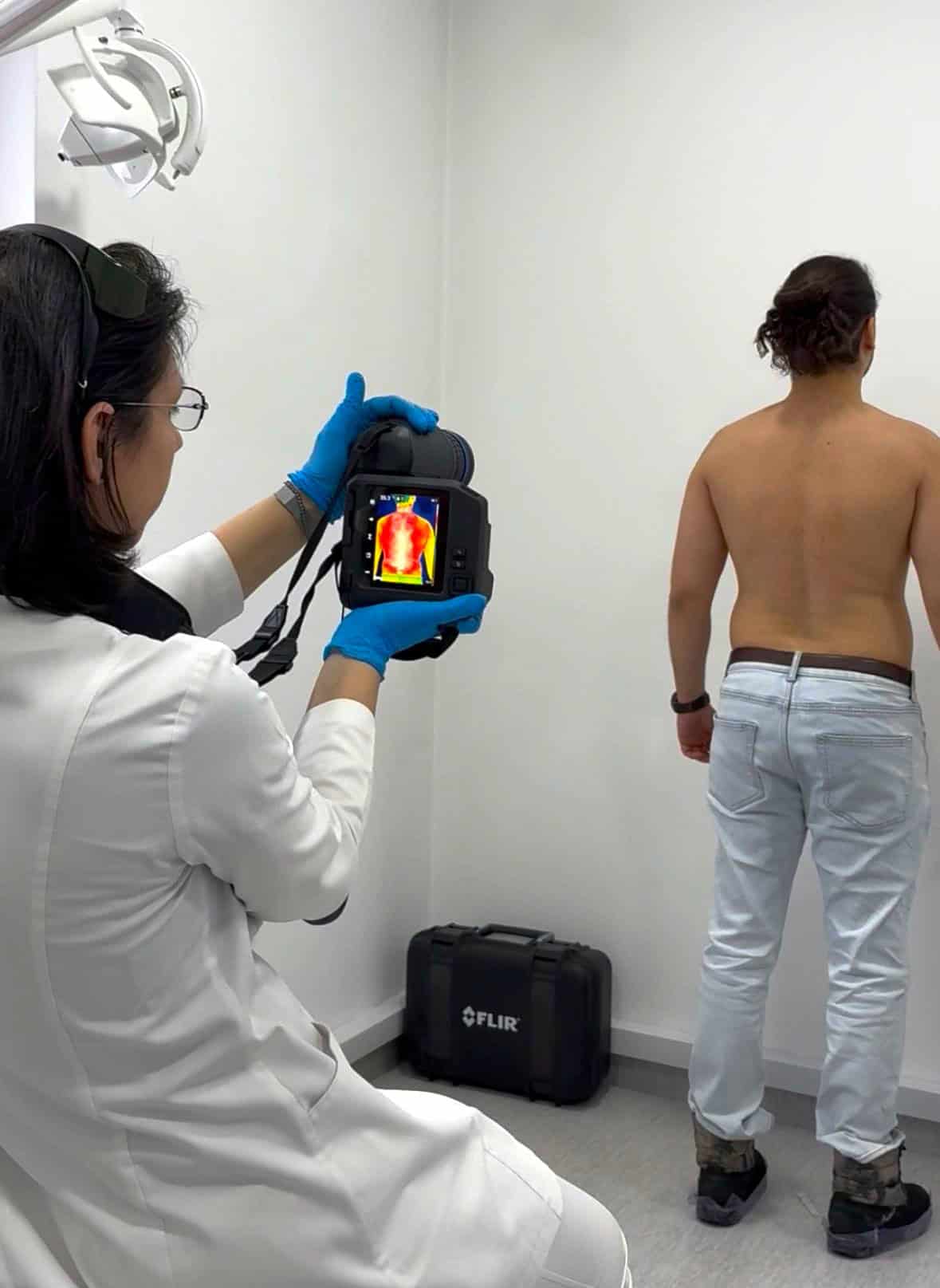
This is one of the most interesting things medicine has demonstrated in the last two decades. Many patients are surprised when I tell them that a herniated disc is not necessarily a permanent change. In fact, in certain situations, the body can naturally reduce the size of a hernia, through a process called spontaneous resorption.
At first glance, it seems hard to believe. How can a piece of a disk “disappear”?
The explanation lies in the extraordinary way our immune system works.
When a portion of the disc's nucleus protrudes outside the fibrous ring, the body may recognize it as tissue in the wrong place. An inflammatory response develops around the herniation, new blood vessels begin to form, and certain immune cells – particularly macrophages – participate in the progressive breakdown and reabsorption of the herniated material.
Meta-analyses published in recent years have shown that this phenomenon is much more common than previously thought. Extruded and sequestered hernias have an even greater probability of spontaneous resorption than contained protrusions.
This is one of the reasons why, when there are no severe neurological signs, guidelines most often recommend conservative treatment before considering surgery.
Why don't we just treat the MRI?
There's a situation I encounter very often. The patient comes in scared because they read the MRI conclusion before seeing the doctor.
Write “hernia de disco L4-L5” or “protruzia L5-S1” and from that moment on, start believing that this is the explanation for all of their pain.
In reality, imaging must always be interpreted in a clinical context. There are people with voluminous hernias who have no symptoms, and there are patients with minimal changes who experience intense pain.
Therefore, in modern rehabilitation, we don't treat the image, but the patient. We are interested in where it hurts, how it hurts, when the pain appears, what movements aggravate it, what functional limitations exist, and how all of this influences daily life. An MRI is extremely valuable, but it cannot tell the whole story on its own.
Recovery means restoring confidence in movement.
One thing I frequently observe is that after an episode of sciatica, many patients develop a fear of movement. They avoid bending over. They avoid lifting objects. They avoid sports. Sometimes they even avoid walking long distances.
It's a natural reaction. If a certain movement caused intense pain, the brain tries to avoid it to protect the body. The problem is that this protection can become excessive.
Muscles lose strength, mobility decreases, and the spine begins to be strained inefficiently. This creates a vicious cycle in which lack of movement sustains pain, and pain causes even less movement.
The role of rehabilitation is to break this cycle. Not by forcing the patient to endure pain, but through a carefully dosed progression, adapted to each stage of healing.
What role does photobiomodulation play in disc herniation recovery?
In recent years, photobiomodulation (PBM) has become one of the most studied fields in regenerative medicine. The mechanism is different from what most people imagine. It does not “burn” the disc. It does not “melt” the hernia. It does not push the disc back into place.
Light used in photobiomodulation works at the cellular level.
It is absorbed by mitochondria, the structures responsible for producing ATP, the main energy source for cells. By stimulating cellular metabolism and influencing biological pathways involved in inflammation and regeneration, PBM can help reduce pain and support functional recovery.
Scientific literature in recent years shows that photobiomodulation can be useful as a complementary therapy for low back pain and radiculopathy, especially when integrated into a comprehensive rehabilitation program, alongside therapeutic exercises and patient education.
It is not a miraculous solution and does not replace surgery when it is necessary. But it can represent a valuable component of conservative treatment, when the indication is correct and the therapeutic parameters are chosen based on scientific evidence.
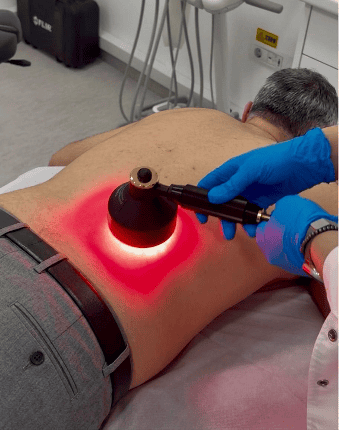
Giant Laser Cluster – Why does the size of the treated area matter?
In the recovery of spinal conditions, we do not treat a single painful point. The paravertebral muscles, thoracolumbar fascia, ligaments, zygapophyseal joints, and sometimes the nerve root pathway are involved.
This is why Expert Laser Center use the system too Giant Laser Cluster (GLC) developed by THOR Photomedicine, a world leader in photobiomodulation research and development.
Unlike spot lasers, Giant Laser Cluster allows for the treatment of extensive anatomical areas in a reduced time, distributing light energy uniformly and making it possible to simultaneously address multiple structures involved in the recovery process.
This technology is always used as part of a personalized treatment plan and not as a standalone treatment.
Why Expert Laser Center?
I believe that the medicine of the future will not belong to clinics with the most equipment. It will belong to clinics that best understand the biology of healing. Expert Laser Center Each patient is evaluated individually, and the therapeutic plan is developed based on the mechanisms that generate pain and functional limitation. Our protocols are developed based on evidence-based medicine and the latest international research in the field of rehabilitation and photobiomodulation.
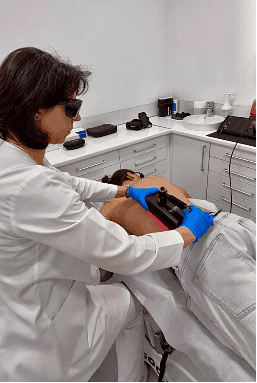
Expert Laser Center operates within the same medical ecosystem as Innovation Medical Center, associated center and European partner of Sigmund Freud University Vienna and and AALZ Aachen (Germany), being affiliated International Society for Laser Dentistry (ISLD).Our activities are inspired by the research and educational programs developed by THOR Photomedicine, a world leader in medical laser therapy and photobiomodulation.
For us, technology is not just high-performance equipment, but rather a continuous investment in education, research, and the implementation of scientifically validated protocols, so that patients in Romania can benefit from treatments aligned with international standards.
Frequently Asked Questions
Yes. In the absence of surgical indications, most patients benefit initially from conservative treatment, and many hernias can reduce spontaneously over time.
Not necessarily. The pain and size of a hernia are not always directly related.
No. In general, prolonged use can lead to muscle weakening if not recommended in a specific context.
In most cases, yes. Adapted physical activity is recommended by current guidelines.
Yes. After symptom control and functional recovery, most patients can gradually return to sports activities with an adapted and supervised program.
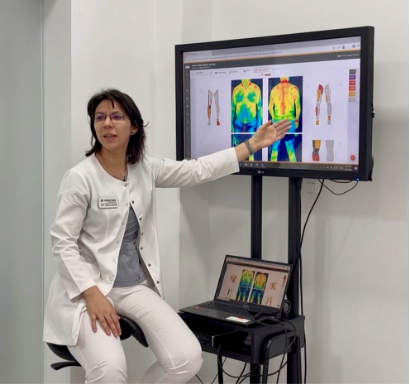
The Science of Healing
A herniated disc doesn't mean the end of an active life. It means the beginning of a process in which the body needs to be helped to regain its balance.
Healing doesn't just depend on the intervertebral disc. It involves the nerves, muscles, inflammation, movement, and the brain's ability to regain confidence in its own body.
Therefore, modern rehabilitation aims not only to reduce pain, but to restore function and support the body's natural regenerative mechanisms. When treatment is individualized and evidence-based, the body, in most cases, has a remarkable capacity for adaptation and recovery.
📍 Expert Laser Center – Bucharest
🌐 Website: https://expertlaser.ro
📞 Telephone +40753666111
Author: Dr. Anca Adam
Specialist in Physical Medicine and Rehabilitation, neurological recovery compartment, Competence in Traditional Chinese Medicine (Tai Yuan China), Expert in Laser Acupuncture & Medical Thermography (Barcelona, Spain) – LSO (Laser Safety Officer) AALZ Aachen Germany

 Romanian
 English