
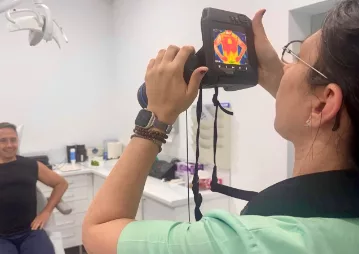
„Doctor, if I keep my arm by my side, it hardly hurts at all, but the moment I try to take something from a shelf, to I I dress with a blouseă or even brush my hair... I feel a sharp pain. What is happening?”
This is one of the most common descriptions I hear in my office. Most of the time, the patient is convinced they have torn a tendon or that surgery is inevitably coming next. Others believe it is „just a strain” that will go away on its own.
The truth is that none of these conclusions is always correct.
Pain that occurs only when you raise your arm is a symptom, not a diagnosis. And to understand where it comes from, we must first understand how one of the most complex joints in the human body works.
The shoulder is built for mobility, not stability
The shoulder is the joint with the greatest range of motion in the body. It allows us to raise our arm above our head, get dressed, drive a car, play sports, and perform hundreds of seemingly mundane gestures.
This freedom of movement, however, comes with a price.
Unlike the hip, where the femoral head is well contained within a deep socket, the humeral head is supported by a much smaller socket. Shoulder stability depends largely on the tendons, ligaments, and muscles surrounding it.
Among the most important structures are rotator cuff, a group formed by several muscles and their tendons. Their role is not only to move the arm, but also to keep the humeral head perfectly centered during every movement. When this balance is lost, pain and functional limitation occur.
Why does it hurt only when you raise your arm?
Many patients notice that they can keep their arm by their side without any issues, but pain appears as soon as they try to raise it laterally or forward. This is explained by what happens inside the joint.
During arm elevation, the rotator cuff tendons and the subacromial bursa pass through a narrow space located beneath the acromion. If this space becomes smaller or if the tendons are already irritated, every movement can cause compression and pain.
That is why many people describe a very characteristic phenomenon: between approximately 60 and 120 degrees of lifting pain appears, and after the arm passes this zone, the discomfort may even decrease. This phenomenon is known in the specialized literature as „painful arc” and represents an important clinical clue, although it is not specific to a single condition.
It is not always a tendon tear
One of the biggest fears of patients is that any shoulder pain means a torn tendon. In reality, most cases have other causes.
Pain can occur in rotator cuff tendinopathy, subacromial bursitis, impingement syndrome, long head of the biceps tendinopathy, or even due to poor coordination between the scapula and the humerus.
There are, of course, partial or complete tendon tears as well, but these are only one possibility and must be confirmed by a clinical examination and, when necessary, by imaging studies.
Sometimes the problem is not in the tendon, but in the way the shoulder moves
This is an aspect that is still talked about too little. Raising the arm is not achieved solely by the shoulder joint. The scapula must rotate harmoniously on the thorax, and the muscles that control it must function synchronously. If this mechanism is disrupted – a phenomenon known as scapular dyskinesia – the stress on the tendons increases, even if they are initially healthy.
In other words, sometimes the tendon hurts not because it is „weak,” but because it is forced to work in an unfavorable biomechanical context. This is one of the reasons why modern recovery does not focus only on where it hurts, but on the entire functional chain of the upper limb.
When is an MRI needed?
Many patients directly request an MRI, convinced that only this can establish the diagnosis. In reality, things are more nuanced.
In many situations, a careful clinical examination provides extremely valuable information. Musculoskeletal ultrasound, performed by an experienced physician, can dynamically evaluate the rotator cuff tendons, the bursa, and the biceps tendon, often being sufficient to guide the diagnosis.
An MRI is recommended especially when there is suspicion of a major tear, persistent symptoms that do not respond to treatment, or when the test result can change the therapeutic strategy. In other words, not every shoulder pain immediately requires an MRI.
What does modern treatment look like?
In the past, treatment often meant anti-inflammatory drugs, rest, and eventually injections. Today we know that this approach is often incomplete.
For most patients, conservative treatment represents the first option and aims to identify the cause of the pain, reduce tendon overload, and restore normal movement control. Progressive therapeutic exercises represent one of the most important components of recovery. Their goal is not only to strengthen the muscles, but also to restore the coordination between the scapula, the rotator cuff, and the rest of the shoulder girdle.
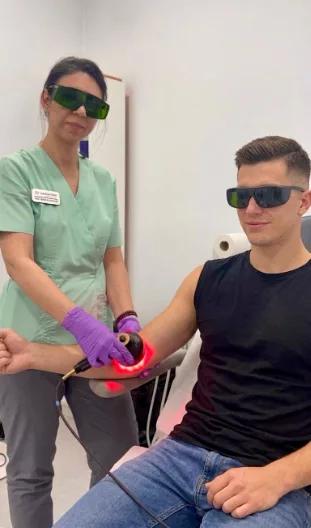
Depending on each case, the program may include manual therapy, patient education, adaptation of daily activities, and other complementary methods.
What role can photobiomodulation have?
In recent years, photobiomodulation (PBM) has been intensively studied in the treatment of tendinopathies and shoulder pain as well.
By using specific wavelengths, light can influence biological mechanisms involved in cellular metabolism, inflammation regulation, and tissue repair processes. Studies suggest that, when integrated into a comprehensive recovery program, photobiomodulation can contribute to pain reduction and functional improvement.
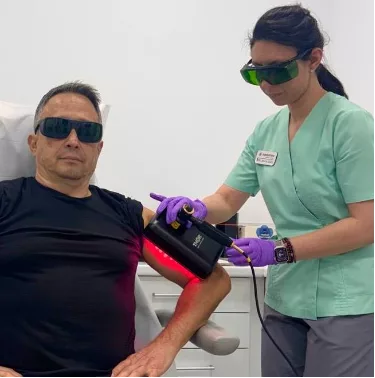
However, it is important to understand that light therapy does not replace exercise and does not repair a torn tendon on its own. It represents a component of a complex, evidence-based therapeutic strategy.
The Expert Laser Center, photobiomodulation is integrated into a personalized recovery plan. The protocols are built based on international scientific literature and use technologies developed by THOR Photomedicine, including the system Giant Laser Cluster, which allows the efficient treatment of extensive anatomical regions. Expert Laser Center operates within the same medical ecosystem with Innovation Medical Center, associated center and European partner of Sigmund Freud University Vienna and and AALZ Aachen, being affiliated International Society for Laser Dentistry (ISLD).
Myth or reality?
„If it hurts when I raise my arm, I definitely have a torn tendon.” — With. Pain can have numerous causes, and a rupture is just one of them.
„Shoulder pain goes away if I rest it completely.” — With. Absolute bed rest can lead to loss of mobility and strength. In most cases, measured movement and adapted exercises are essential.
„All rotator cuff tears must be operated on.” — With. Many partial tears and even some complete tears can be treated conservatively, depending on age, activity level, and functional deficit.
„If the MRI is normal, the pain is imaginary.” — With. Pain is a complex phenomenon, and sometimes functional and biomechanical changes are not evident on imaging.
Frequently Asked Questions
Because certain positions place more demand on the tendons, bursa, or other structures of the shoulder. The location and timing of the pain provide important clues for diagnosis.
Yes. Night pain is common in rotator cuff tendinopathies and subacromial bursitis, but it can also occur in other shoulder conditions.
Generally, no. Adapted movement and exercises recommended by a doctor or physical therapist are most of the time part of the treatment.
If the pain occurs after a significant trauma, if you can no longer raise your arm at all, if a visible deformation, fever, intense redness, or sudden loss of strength appears, rapid medical evaluation is necessary.
Shoulder pain is rarely about a single tendon or a single structure. It reflects how the tendons, muscles, shoulder blade, and joint work together. When this balance is lost, the body sends out an alarm signal: pain.
Modern recovery aims to understand why that imbalance occurred and to correct it, rather than just temporarily reducing symptoms. In many situations, this means regaining correct movement, supporting natural healing processes, and returning to daily activities without pain. This is the philosophy of regenerative medicine and the approach we apply at Expert Laser Center.
📍 Expert Laser Center – Bucharest
🌐 Website: https://expertlaser.ro
📞 Phone: +40753666111
Author: Dr. Anca Adam
Specialist in Physical Medicine and Rehabilitation, neurological recovery unit, Competency in Traditional Chinese Medicine (Tai Yuan China), Expert in Laser Acupuncture & Medical Thermography (Barcelona, Spain) – LSO (Laser Safety Officer) AALZ Aachen Germany

 Romanian
 English