
No, two devices that emit red light do not automatically provide the same treatment. photobiomodulation wavelength, delivered energy, exposure time, treated area, and patient diagnosis matter. More power does not necessarily mean a better result, The treatment must be tailored to the patient.
This is one of the questions I naturally receive from patients: if there are red light headphones, bands, and lamps on the internet, why would anyone still need a treatment in a clinic? The question is a very good one.
The answer begins with a distinction that marketing rarely makes: The color of light alone does not describe the treatment.
„Red light therapy is a very broad term
A light may appear red to our human eye and nothing more. In photobiomodulation, however, we discuss measurable parameters: wavelength, power, irradiance, energy, exposure time, surface area, and session frequency. In addition, what we want to treat matters.
It is the difference between saying „I am taking a medication” and specifying which medication, at what dose, for how long, and for what diagnosis.
Therefore, when reading a study reporting a favorable outcome of PBM, we cannot conclude that any device shining a red light on the scalp will automatically reproduce that result.
Laser or LED: Which Is Better?
The answer might surprise you: We can't simply say that the laser is good and the LED is weak. Both can be used in photobiomodulation.
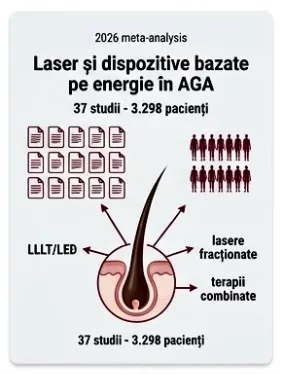
In fact, the 2025 meta-analysis on alopecia included both low-level laser and LED therapies and found a significant effect on hair density in androgenetic alopecia. Therefore, the useful question is not just „laser or LED?”, but:
What are the device's specifications? What dose reaches the tissue? What area are we treating? For what diagnosis? And according to what protocol?
Does "stronger" mean "more efficient"?
No.
This is one of the concepts that deserves a thorough explanation because we tend to associate a more powerful device with a more effective one. In photobiomodulation, we aim to elicit a biological response, and the effect depends on the dose. An uncontrolled increase in energy does not guarantee an increase in the therapeutic effect.
That is why, Dosage is part of the treatment. We don't want "as much light as possible." We want the right parameters for the biological target we're aiming for.
So what sets a medical protocol apart?
First of all, the fact that it doesn’t start with the device. One patient may have androgenetic alopecia. Another may have telogen effluvium. Yet another patient may have inflammatory or scarring alopecia, which requires an entirely different approach.
Everyone can say the same sentence: „"My hair is falling out."” A quality protocol begins by distinguishing between these situations. Only then does it make sense to discuss technology.
Why do we use THOR technology at Expert Laser Center?
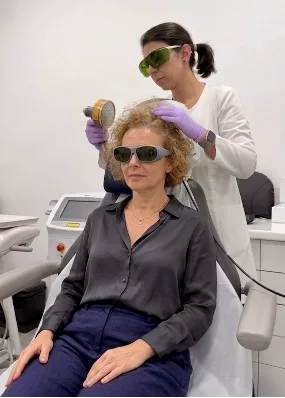
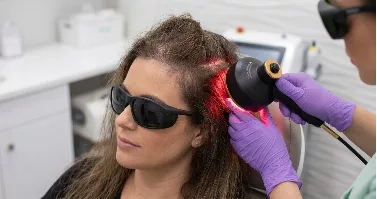
At Expert Laser Center, we work with THOR Photomedicine photobiomodulation systems designed for professional use. One of the practical advantages is the ability to use applicators that allow for the controlled coverage of scalp areas within defined protocols.
THOR has separate professional documentation for androgenetic alopecia/alopecia areata and for stress-related telogen effluvium. This distinction is important because it reflects a simple medical principle: Hair loss is not a single disease.
However, the manufacturer’s protocols should not be confused with an international clinical guideline and do not replace medical diagnosis or judgment. Furthermore, the approval status of an indication may vary depending on the device and jurisdiction. Stating this does not diminish the technology. On the contrary, this is the correct way to use it.
What do „quality standards” mean in laser treatment?
It means being able to answer a few simple questions.
What are we treating? Do we have a diagnosis, or at least a sufficiently well-founded clinical hypothesis?
What do we treat? Are there any viable follicles for which treatment might be appropriate?
How do we treat it? Do we have parameters and a reproducible protocol?
How do we know if it works? Is progress monitored objectively, or do we rely solely on the patient's impression?
What does the literature say about efficiency?
The most consistent results have been observed in androgenetic alopecia. The meta-analysis by Perez et al. found a significant increase in hair density following LLLT compared to placebo. It included 38 studies and over 3,000 patients, most of whom had androgenetic alopecia. https://pubmed.ncbi.nlm.nih.gov/39404126/
In 2026, a review of 37 studies and 3,298 patients estimated an average difference for LLLT of 18.56 threads/cm² in hair density and 10,62 μm in terms of thread thickness compared to sham. https://pubmed.ncbi.nlm.nih.gov/42339398/
This is an argument in favor of PBM, not of just any product labeled „red light.”.
What about smart home devices?
Some home-use devices have even been evaluated in clinical trials, and older literature has reported favorable results, including for helmet-type devices and combs, in the treatment of androgenetic alopecia. A meta-analysis of randomized trials identified a significant increase in hair density compared to sham treatments in both women and men.
The problem is different.
We cannot extrapolate the results of a studied device to any product bought online.
If the parameters differ, we are no longer necessarily talking about the same intervention.
Myth or medicine?
„Laser is always better than LED.” — Myth.
Both sources can be used in PBM. The parameters and the protocol matter.
„If the light is stronger, the result is better.” — Myth.
Dosage is essential in photobiomodulation.
„If I don't feel heat, the treatment isn't working.” — Myth.
PBM targets non-thermal photobiological effects.
„Any red lamp can reproduce LLLT studies.” — Myth.
The results belong to the evaluated devices and protocols, not to the red color itself.
Frequently Asked Questions
There are home-use devices studied for androgenetic alopecia, but not every red lamp is equivalent to them. The indication and parameters of the device must be known.
Low-level photobiomodulation aims for non-thermal effects and should not be confused with ablative or surgical lasers.
This generalization cannot be made. LEDs and lasers are different light sources and both can be used for PBM.
This is not a justified conclusion. More treatment does not automatically mean a better biological effect.
Through repeated evaluations under conditions that are as standardized as possible and, when indicated, through objective methods of scalp and hair evaluation.
Because different types of alopecia have different mechanisms, prognoses, and treatments. A good technology used for the wrong indication remains a wrong choice.
Technology is important. Guidance is even more important.
At Expert Laser Center, we chose to work with THOR medical technology and protocols controlled by photobiomodulation.
For the patient, the real difference is made by the diagnosis, the correct indication, the choice of parameters, and the monitoring. That is where personalized medicine begins.
📍 Expert Laser Center – Bucharest
🌐 Website https://expertlaser.ro
📞 Telephone +40753666111
Author: Dr. Anca Adam
Specialist in Physical Medicine and Rehabilitation, neurological recovery compartment, Competence in Traditional Chinese Medicine (Tai Yuan China), Expert in Laser Acupuncture & Medical Thermography (Barcelona, Spain) – LSO (Laser Safety Officer) AALZ Aachen Germany

 Romanian
 English