
Does your jaw hurt in the morning? Do you feel it is tight, that it deviates when you open your mouth, or that it no longer moves as freely? You may already have received the advice: „Do some exercises for the ATM”.
It is a good advice only half-baked! Therapeutic exercise has a real place in the recovery of temporomandibular (TMJ) dysfunction, and the medical literature supports its use. The problem arises when the same set of exercises is recommended to all patients, regardless of the cause of the pain.
A painful joint does not necessarily need more movement. First of all, we need to understand why it hurts.
What does the literature say about exercises for the ATM?
A meta-analysis published in Clinical Rehabilitation, The study, which included 16 studies and 812 patients, showed that therapeutic exercise can reduce pain and improve both the active and passive opening of the mouth. https://pubmed.ncbi.nlm.nih.gov/36263523/
The results are also supported by the clinical guideline published in BMJ for chronic pain associated with TMD. It formulates strong recommendations for supervised mandibular exercise and stretching, supervised postural exercise, and other active conservative interventions. https://www.bmj.com/content/383/bmj-2023-076227?utm_source=chatgpt.com
A 2023 review, however, reaches a conclusion that deserves attention: the exercises appear effective, especially those of coordination, but the studies are very different from each other and we still do not have universal parameters regarding the optimal type, dose, and frequency. https://pubmed.ncbi.nlm.nih.gov/37521175/
In other words, the evidence supports therapeutic exercise, It’s not a universal „10 repetitions three times a day for any ATM” recipe.
Why can't we treat all ATM dysfunctions with the same exercises?
Because TMD is not a single disease. Behind the same phrase — „my jaw joint hurts” — we can find predominantly muscular pain, arthralgia, disc displacement with reduction, disc displacement without reduction, and limitation of opening, hypermobility, or a combination of these.
In addition, the function of the mandible does not depend exclusively on the joint. The masticatory musculature, the capsular-ligamentous structures, the articular disc, neuromotor control, the cervical region, and behaviors such as repeated clenching of the teeth are all involved.
That is why, The purpose of the exercise may be different from one patient to another.relaxation, motor control, mobility, coordination, the progressive increase of tolerance to movement, or the recovery of a lost function.
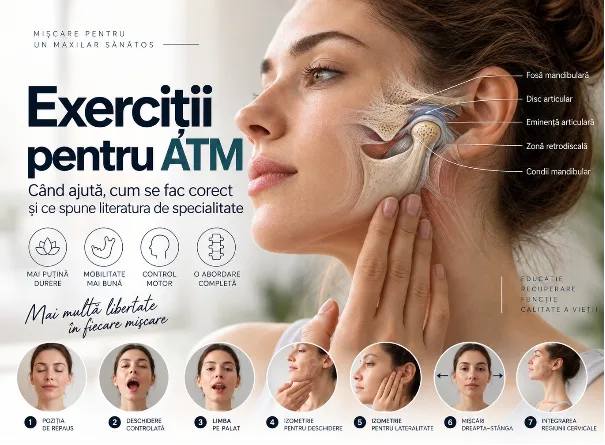
7 exercises used in ATM recovery
The exercises below are educational examples, not a universal treatment protocol. If there is mandibular blockage, a recent trauma, significant pain, or progressive limitation of mouth opening, evaluation is indicated before an unsupervised program.
1. Learn the resting position of the mandible
While resting, the teeth should not be kept in constant contact. Simply place the tongue on the palate, relax the jaw, and leave the dental arches without contact. The lips can remain close, without tension.
Does it seem too simple to matter?
For the person who spends hours unknowingly clenching their teeth, it is not at all simple. Reeducating the resting position can help reduce the muscle strain caused by repeated non-functional tooth contact.
2. Controlled opening in the mirror
Stand in front of the mirror and slowly open your mouth to a comfortable extent. Close it as slowly as possible. Follow the movement of your jaw. Is it relatively centered? Is it deviating? Draw a „S” shape? Is there a jump when you click?
The mirror provides visual feedback. The goal is not to open your mouth as much as possible, but to practice, when indicated., a slow and controlled movement.
3. Opening with the tongue on the palate
Place the tip of the tongue on the palate, immediately posterior to the upper incisors, and slowly open the mandible while maintaining contact with the tongue. The movement is intentionally limited. The exercise can be used to control the opening motor, not to achieve the maximum amplitude.
If significant pain or blockage occurs, do not force the movement.
4. Isometrics for opening
Place your hand lightly under the chin and try to initiate the opening of the mouth while the hand exerts a slight resistance. The jaw moves very little or not at all. This is an isometric contraction.
The resistance should be gentle. The goal is not to „train the jaw” with maximum force, but to work the neuromuscular function in a controlled manner.
5. Isometrics for laterality
Apply a slight resistance with your hand to the side of the mandible and try gently moving it in that direction without producing a large movement. It can be done bilaterally if the diagnosis allows.
If severe joint pain, blockage, or a feeling of instability occurs, the exercise is stopped.
6. Controlled movements right-left
The jaw does not function only vertically. Laterality is essential for chewing. Slow right-to-left movements, performed at a comfortable amplitude, can be integrated into coordination and mobility programs.
Again, the goal is the quality of the movement, Not the maximum amplitude.
7. Don't forget the cervical region
Sometimes, the patient comes in for the jaw and a significant part of the evaluation takes place… at the neck level. Not because „any incorrect posture causes ATM,” but because the cranio-mandibular and cervical systems are functionally and neuromusculately interconnected.
A simple cervical control exercise may involve gently pulling back the back head, keeping the gaze forward, without excessive flexion or extension.
There is also scientific support for the cervical approach in certain TMDs. A 2024 meta-analysis found favorable short-term effects of cervical recovery interventions on pain in adults with myogenic TMD, although the authors emphasize the need for better data on long-term results. https://pubmed.ncbi.nlm.nih.gov/38454576/
How many repetitions do you need to do?
Here, the medical response is less spectacular than on social media: It depends. There is no universally validated dose for all TMDs. The literature uses different protocols, and the heterogeneity of physiotherapy studies remains an important issue. The dose must be adapted to the diagnosis, the tissue irritability, the pain, the available amplitude, and the objective being pursued.
A patient with limited mobility does not automatically have the same program as one with hypermobility. And a patient with myofascial pain does not have to be treated automatically as someone with an intraarticular pathology.
If the ATM pops up, the exercises have to make the click disappear?
No.
A click may occur, among other things, during the movement of the joint disc with reduction. But the joint sound, taken in isolation, does not establish the need for treatment or its type. What matters is whether there is pain, blockage, functional limitation, and what clinical diagnosis explains the symptoms.
The goal of treatment is not to hunt down any joint noise. The goal is to restore function and to control the relevant clinical symptoms.
When SHOULD you not start exercising for the ATM on your own?
A sudden jaw lock is not the right time to test all the exercises found online. It is advisable to evaluate if there is a significant or progressive reduction in mouth opening, severe or increasing pain, recent trauma, dislocation or feeling of instability, swelling, fever or other important inflammatory signs or associated neurological symptoms.
In these situations, the correct question is not „What exercise should I do?”, but „Why isn’t the jaw moving normally anymore?”
How do we view the exercise in modern ATM recovery?
One of the important ideas drawn from current literature is the transition from the patient treated exclusively passively to the patient actively involved in recovery. BMJ For chronic TMD pain, several interventions that encourage movement, activity, and self-management are favored, including supervised mandibular exercise and postural exercise. https://www.bmj.com/content/383/bmj-2023-076226?utm_source=chatgpt.com
A more recent review suggests that both specific mandibular exercises and some general exercises can have beneficial effects on activity, participation, and quality of life. https://pubmed.ncbi.nlm.nih.gov/40490989/
Therefore, the exercises for the ATM are not „gymnastics for the jaw”, they are a therapeutic intervention that must be chosen and dosed according to the problem we are trying to solve.
FAQ
It can reduce pain and improve mobility and function in certain TMDs, but there is no single exercise that treats all diagnoses. Available meta-analysis supports favorable effects on pain and mouth opening. https://pubmed.ncbi.nlm.nih.gov/36263523/
Sometimes, yes. However, the click alone does not determine the treatment. If it is associated with pain, locking, or functional limitation, an evaluation is useful before choosing the program.
No. Intense pain, persistent worsening after exercise, or the onset of locking are reasons to stop the program and re-evaluate.
In some people with myogenic TMD, cervical interventions can reduce pain in the short term. However, this does not mean that every ATM dysfunction originates from the cervical spine.
Do not try to achieve maximum opening by repeated force. The blockage may have joint, muscle, or other causes, and the treatment depends on the diagnosis.
The duration and frequency depend on the diagnosis and clinical response. The literature does not support a single repeat scheme that is valid for all TMDs.
The right exercise starts with the right diagnosis
In the recovery of temporomandibular dysfunction, we are not just interested in how much The mouth opens. We are interested in how the mandible moves, where the pain occurs, which structures are involved, and what happens to the patient's function.
That is why we sometimes prescribe mobility. Other times we control motor function. Sometimes we work the masticatory musculature and the cervical region. And other times the first thing we do is to We are not forcing the joint until we establish the cause of the limitation.
The Expert Laser Center, The ATM recovery starts with functional evaluation and clinical diagnosis, and the exercise program is chosen based on the mechanism of dysfunction and adapted along the way based on the response.
Because the useful question is not: „What is the best exercise for the ATM?” But: „Which exercise is suitable for my ATM?”
ATM disorders lie on the border between medical recovery and dental medicine. When the clinical picture also requires evaluation of the articular, dental, and occlusal components, the patient can benefit from an interdisciplinary evaluation within the framework of the Innovation Medical Center – evaluation and treatment ATM.
📍 Expert Laser Center – Bucharest
🌐 Website https://expertlaser.ro
📞 Telephone +40753666111
Author: Dr. Anca Adam
Specialist Doctor in Physical Medicine and Rehabilitation, Department of Neurological Rehabilitation, Competent in Traditional Chinese Medicine (Tai Yuan China), Expert in Laser Acupuncture & Medical Thermography (Barcelona, Spain), LSO (Laser Safety Officer) AALZ Aachen Germany

 Romanian
 English