
Yes. For alopecia androgenetic are there proofs today that photobiomodulation with light from the spectrum redu and near-infrared can increase hair density in some patients. However, it is not a universal treatment for all hair loss. The result depends on the diagnosis, follicle viability, light parameters, and treatment consistency.
Hair loss is one of the problems for which people end up trying almost anything: vitamins, shampoos, oils, drug treatments, supplements, injections, and, increasingly, red light devices.
„Meanwhile, ”red light therapy" has also become a very prominent term on social media. Beyond the trend, however, there is a legitimate question: Can light really affect hair follicles? In certain situations, the answer is yes. But the explanation is more interesting than the promise of a lamp that „makes hair grow.”.
What is photobiomodulation?
Photobiomodulation, or PBM, is a medical procedure that uses non-ionizing light, at specific parameters, to modulate certain biological processes. It is not a natural remedy, nor is it a laser that burns or removes tissue.
PBM uses laser or LED sources, typically in the red and near-infrared spectrum. The light can interact with cellular processes involved in metabolism, signaling, inflammation, and tissue repair. On the scalp, the medical interest lies in the potential to support the activity of follicles that are still viable and the hair growth cycle.
There is, however, one important limitation: Light cannot restore a hair follicle that has been permanently destroyed. That is precisely why, before we talk about treatment, we need to talk about diagnosis.
„My hair is falling out” is not a diagnosis
Two people can observe apparently the same problem and have completely different causes. It can be androgenetic alopecia, telogen effluvium after stress, illness, childbirth, or surgery, alopecia areata, endocrine or nutritional disorders, medication side effects, or inflammatory and scarring forms of alopecia.
In androgenetic alopecia, predisposed follicles progressively miniaturize, producing increasingly finer strands of hair. In telogen effluvium, a larger number of follicles may enter a specific stage of the follicular cycle, and hair loss becomes apparent later on.
These situations should not automatically be treated the same way.
What do studies say?
That's where literature became much more interesting.
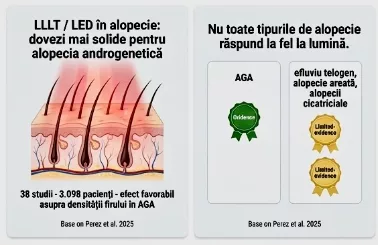
A systematic review and meta-analysis published in Dermatology Surgery analyzed 38 studies and 3,098 patients. Of these, 2,930 had androgenetic alopecia. In this category, low-level laser/LED therapy resulted in a significant increase in hair density compared to placebo, both in studies lasting less than 20 weeks and in those with longer treatment periods. However, for telogen effluvium, alopecia areata, and other types of alopecia, there was insufficient data for a similar meta-analysis.
Therefore, In 2026, the strongest evidence for PBM continues to be that regarding alopecia androgenetic.
What do the latest data from 2026 tell us?
A meta-analysis published in May 2026 examined 37 studies, totaling 3,298 patients with alopecia androgenetic.For LLLT, the cumulative analysis showed an average increase in the density of 18.56 threads/cm² and of the wire thickness 10,62 μm. The adverse events reported were generally mild and transient. The figure of 18.56 obviously does not mean that every patient will grow exactly 18 new hairs per square centimeter. It is an average obtained by combining the results of various studies.
But it tells us something important: photobiomodulation in alopecia androgenetic It can no longer be reduced to a mere wellness trend. There is a measurable effect in the clinical literature.
And what if my hair is falling out from stress?
Here, the evidence is more limited. A 2024 study retrospectively analyzed 140 patients with post-COVID telogen effluvium, with or without associated androgenetic alopecia. After 12 weeks, cessation of hair loss and a negative pull test were more common in the groups that received LED therapy; favorable changes in certain trichoscopic parameters were also observed.
It's interesting and promising, but it doesn't provide the same level of evidence as a series of randomized trials. So, when it comes to telogen effluvium, we're talking about encouraging data, not about proven efficacy at the same level as in androgenetic alopecia.
How long does it take for hair to grow?
Patience is key here. The hair follicle has its own biological cycle, and changes cannot be assessed after just two or three sessions. In the 2025 meta-analysis, treatment protocols for androgenetic alopecia lasted approximately 4–26 weeks.
Therefore, the results must be monitored over time and, ideally, assessed using reproducible methods: standardized photographs and, when available and appropriate, dermatological/trichoscopic evaluation. A photograph taken today in bright light and another taken three months later, from a different angle and with the hair styled differently, does not constitute a reliable method of evaluation.
Is red light a natural treatment?
It is more correct to talk about a intervention physical light-based whose effects depend on measurable parameters and the medical indication. And the fact that a procedure is non-invasive does not mean it can be used indiscriminately; it requires medical evaluation and treatment with clear doses prescribed by an experienced physician.
How do we use photobiomodulation at Expert Laser Center?
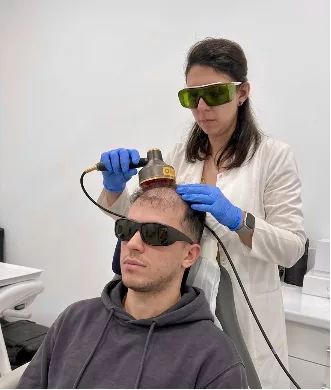
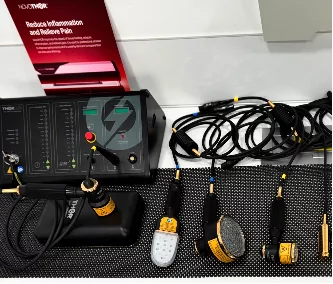
At Expert Laser Center, we use photobiomodulation medical technology developed by THOR Photomedicine. THOR Laser features distinct professional protocols for various situations associated with hair loss.
The starting point is the question: why is this patient's hair falling out?
Only after the evaluation can it be determined whether photobiomodulation is a reasonable indication, whether a dermatological evaluation or additional investigations are needed, and how it can be integrated into a broader therapeutic plan.
Frequently Asked Questions
For androgenetic alopecia, there are randomized studies and meta-analyses showing a significant increase in hair density compared to placebo. However, an individual response cannot be guaranteed.
Yes. Photobiomodulation is non-invasive and does not involve injecting any substance into the scalp.
There is promising data on telogen effluvium, but the evidence is more limited than for androgenetic alopecia.
We're talking about weeks and months, not just a few sessions. The timeline depends on the diagnosis, the treatment protocol, and the individual's response.
There is no guarantee that a damaged follicle will regenerate. The viability of the follicles and the cause of alopecia are key factors.
In studies on androgenetic alopecia, it generally demonstrated a good safety profile. The 2026 meta-analysis describes the reported adverse reactions as predominantly mild and transient.
For alopecia androgenetic There is now a body of evidence that supports photobiomodulation as a non-invasive treatment option. For other forms of alopecia, the literature is still evolving.
DAccurate diagnosis, controlled parameters, and monitoring of results are extremely important elements.
At Expert Laser Center, light is the tool. Medicine determines when and how it should be used.
References
Perez SM, Vattigunta M, Kelly C, Eber A. Low-Level Laser and LED Therapy in Alopecia: A Systematic Review and Meta-Analysis. Dermatologic Surgery. 2025;51(2):179–183. https://pubmed.ncbi.nlm.nih.gov/39404126/
Gerkowicz A, et al. Red LED light therapy for telogen effluvium associated with long COVID in patients with and without androgenetic alopecia. Ann Agric Environ Med. 2024;31(2):239–247. https://www.aaem.pl/Red-LED-light-therapy-for-telogen-effluvium-in-the-course-of-long-COVID-in-patients,177238,0,2.html
Lasers and Energy-Based Devices in the Treatment of Androgenetic Alopecia: A Systematic Review and Meta-Analysis. 2026. Analysis of 37 studies, 3,298 patients. https://karger.com/sad/article/doi/10.1159/000551411/949063/Lasers-and-Energy-Based-Devices-in-the-Treatment
📍 Expert Laser Center – Bucharest
🌐 Website https://expertlaser.ro
📞 Telephone +40753666111
Author: Dr. Anca Adam
Specialist in Physical Medicine and Rehabilitation, neurological recovery compartment, Competence in Traditional Chinese Medicine (Tai Yuan China), Expert in Laser Acupuncture & Medical Thermography (Barcelona, Spain) – LSO (Laser Safety Officer) AALZ Aachen Germany

 Romanian
 English