
Why a yellowed and thickened nail should not be treated by guesswork and what we know in 2026 about lasers, blue light, and modern antifungal treatments
A nail that turns yellow, thickens, becomes crumbly, or starts to detach from the nail bed is often simply called a „nail fungus.” Sometimes this is indeed the explanation, but not always.
Onychomycosis is a fungal nail infection, most frequently produced by dermatophytes, especially species of Trichophyton, but it can also be caused by yeasts or non-dermatophyte fungi. And it is not just an aesthetic problem: it can cause discomfort, pain, difficulty walking, and tends to persist or recur.
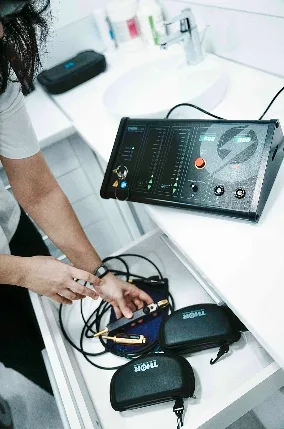
The good news is that today we have more treatment options than the classic „creams or pills.” In addition to topical and systemic antifungals, medicine is increasingly studying the laser, violet-blue light, photodynamic therapy, and combinations of local treatments and light-based technologies.
First: is it really a fungal infection?
This is one of the most important questions.
Nail psoriasis, repeated trauma, onycholysis and other nail dystrophies can resemble a fungal infection. Therefore, before long-term antifungal treatment, the diagnosis may require collecting nail material for microscopic examination, fungal culture, histopathological examination/PAS and/or molecular methods such as PCR, depending on the situation. International guidelines and recommendations support mycological confirmation, especially prior to systemic therapy.
This completely changes the perspective: We do not treat the nail color. We treat its cause.
How is onychomycosis treated conventionally?
The treatment is chosen based on the number of affected nails, the involved surface area, matrix involvement, nail thickness, the identified microorganism, associated diseases, and the patient's treatments.
In mild and moderate forms, they can be used topical antifungals, depending on local availability and approvals. The major disadvantage is that the nail plate represents a difficult barrier to cross, and treatment must be continued for a long time.
In more extensive forms, terbinafine remains one of the treatments with the most solid evidence base, and itraconazole represents another systemic option. The choice requires the evaluation of contraindications and potential drug interactions.
Debridement and nail thinning can also be integrated into the treatment and can improve the response when combined with drug therapy.
And where does the laser come in?
Here is where things get interesting. The nail plate is precisely the obstacle that makes onychomycosis so difficult to treat. Light-based technologies try to act locally, through different mechanisms depending on wavelength, energy used and device type.
Several families of technologies were studied: Nd:YAG 1064 nm, CO₂ lasers, near-infrared diode, 870/930 nm combinations, violet-blue light around 405 nm, 405/635 nm combinations, and photodynamic therapy. In other words, „nail fungus laser” does not describe a single procedure.
Why is blue light so interesting?
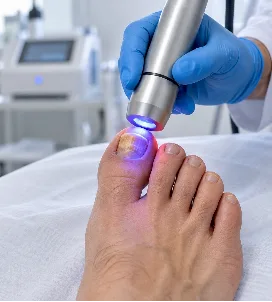
Because here we have a very interesting biological mechanism. Violet-blue light can promote the formation of reactive oxygen species in microorganisms. In experimental studies, this oxidative stress can affect fungal structures and inhibit the development of dermatophytes.
Trichophyton rubrum, one of the main agents of onychomycosis, demonstrated sensitivity to 405 nm in laboratory studies. A study published in 2025 investigated an optimized LED system and identified Lumina blue wavelength with very good antifungal performance in the studied model, the mechanism being associated with the production of ROS and fungal membrane damage.
There is also research on the combination blue with red. An in vivo experimental model reported favorable mycological results after dual treatment, and systems combining these wavelengths have also been investigated clinically for nail onychomycosis.
This is a very interesting direction for photomedicine because it aims a local action, without the systemic exposure specific to an orally administered drug.
But blue is not the only wavelength studied
1064 nm Nd:YAG it is one of the most studied laser technologies for onychomycosis. The targeted mechanism is different and mainly includes photothermal effects on fungal structures. There are studies and meta-analyses with favorable results, but results differ considerably between protocols.
870 and 930 nm, used together, were investigated as a near-infrared approach. A randomized study evaluated four sessions administered over the course of 120 days and reported clinical improvement for some of the treated nails.
Fractional CO₂ laser has a different logic. In addition to its effect on the nail, the microchannels created in the nail plate can facilitate the penetration of a topical treatment or photosensitizer. A meta-analysis dedicated to this technology was published in Dermatologic Surgery in 2026.
And this is precisely where one of the most interesting directions emerges: combination treatment.
Laser + antifungal: can the combination be more efficient?
There are arguments for this strategy. A meta-analysis of randomized studies found better outcomes when topical antifungal treatment was combined with certain laser therapies—including CO₂ and 1064 nm Nd:YAG—compared to topical treatment used alone.
The logic is attractive: we act locally on the fungal environment and, in certain protocols, we can at the same time facilitate the access of topical therapy to the affected structures. However, there is no single optimal protocol for all forms of onychomycosis. The fungal species, nail thickness, matrix involvement, and disease severity can alter the treatment choice.
Does photodynamic therapy work?
This is probably one of the most interesting directions of the moment.
In antimicrobial photodynamic therapy – aPDT, a photosensitizer, such as methylene blue or certain molecules derived from aminolevulinic acid, is applied, after which it is activated with light of an appropriate wavelength. The reaction generates reactive oxygen species with an antimicrobial effect.
A systematic review published in 2025 of clinical studies on aPDT in onychomycosis found reductions in the OSI severity score of approximately 30–90%, with clinical cure rates reported between 20% and 80%. In some protocols combined with fractional CO₂ laser, very good mycological results have been reported. The authors consider the method promising, but emphasize the need for protocol standardization.
Furthermore, in 2026 Journal of the American Academy of Dermatology published an analysis dedicated to interpreting current evidence on PDT in onychomycosis – a sign that this direction has seriously entered the current dermatological discussion.
Does the laser replace antifungal treatment?
We must not view things as a competition between „lasers” and „medications.” In modern medicine, the more useful question is: Which combination makes the most sense for the type of onychomycosis we are facing?
For one patient, topical treatment may be sufficient. For another, systemic therapy may be indicated. In certain situations, light-based local treatment may represent an additional option or can be integrated into a combination protocol.
In 2026, a dedicated update on onychomycosis devices describes the laser, photodynamic therapy, plasma, ultrasound, and other technologies as a promising area of disease management, but also shows that the evidence for devices is still less robust than that for established antifungals. This is important precisely in order to choose technology intelligently, not generically.
How long does it take for a nail to look normal?
Here is where one of the most frequent confusions among patients arises. Fungal can respond before the nail looks normal.
The affected nail must grow and be progressively replaced by a healthy nail plate. On the foot, this process is slow: complete regeneration may require 12–18 months. Therefore, evaluating a treatment after a few weeks can be misleading.
Ideally, we'll track them separately mycological cure – the disappearance of the fungus upon testing – and clinical healing, meaning the appearance of the new nail.
Why does nail fungus keep coming back?
Because treating the nail does not always resolve the source of reinfection.
Tinea pedis („athlete's foot”), contaminated footwear, persistent moisture, perspiration, repeated nail trauma, and repeated exposure to contaminated environments can favor recurrence.
Relapse/reinfection is frequent; some syntheses estimate approximately 25%. Foot hygiene, keeping them dry, simultaneous treatment of tinea pedis, and sanitizing footwear and socks are part of the long-term strategy.
MIT or MEDICINE?
„Any yellow nail is a mycosis.” — MYTH.
Multiple conditions can alter the appearance of the nail. The correct diagnosis comes before treatment.
„Blue light can have an antifungal effect.” — MEDICINE.
Especially around 405 nm, there is experimental evidence for the inhibition of dermatophytes, including Trichophyton. Clinical research is in development.
„There is only one laser for nail fungus.” — MIT.
405/635 nm, 870/930 nm, Nd:YAG 1064 nm, fractional CO₂, and photodynamic therapy were investigated, each through different mechanisms and protocols.
„Combination treatment may be useful.” — MEDICINE.
There are studies that support the association of certain laser therapies with topical antifungal treatment.
„If the fungus is gone, the nail should look normal immediately.” — MIT.
A healthy nail needs to grow. On the foot, this can take many months.
Frequently Asked Questions
The sensation depends heavily on technology. Some systems are non-thermal or produce minimal discomfort, while lasers with a photothermal effect can produce a sensation of warmth. Parameters and protocol are essential.
Yes. Laser treatment can be a valuable option for patients in whom oral antifungals are not indicated, are not well tolerated, or systemic exposure is to be avoided. The laser acts locally on the affected nail, without administering an antifungal medication throughout the entire body. Depending on the type and severity of onychomycosis, it can be used as local therapy or integrated into a protocol that includes nail debridement and topical antifungal treatments.
For these patients, one of the major advantages of laser technologies is precisely the possibility of local, targeted treatment, without the systemic exposure associated with oral antifungals.
In the laboratory, 405 nm can strongly inhibit dermatophytes such as Trichophyton rubrum and T. mentagrophytes. There is also in vivo and clinical research on systems that include 405 nm, but we do not yet have enough comparative clinical studies.
There is no universal number. Protocols differ considerably depending on the device, wavelength, severity of infection, and associated therapies.
No treatment completely eliminates the risk of reinfection. Tinea pedis control, footwear hygiene, and the prevention of persistent moisture are important after treatment.
Main medical references
- Nenoff P, et al. S1 Guideline Onychomycosis. J Dtsch Dermatol Ges. 2023. https://pubmed.ncbi.nlm.nih.gov/37212291/
- Lipner SR, Scher RK. Onychomycosis: Treatment and prevention of recurrence. J Am Acad Dermatol. https://pubmed.ncbi.nlm.nih.gov/29959962/?utm
- Gupta AK, et al. Devices in Onychomycosis: A Status Update. 2026. https://pubmed.ncbi.nlm.nih.gov/42303360/?utm
- Ma W, et al. Laser treatment for onychomycosis: systematic review and meta-analysis. https://pubmed.ncbi.nlm.nih.gov/31770202/
- Zhang J, et al. Laser + topical antifungal therapy: systematic review and meta-analysis of RCTs. https://pubmed.ncbi.nlm.nih.gov/35484440/
- Xiong G, et al. Fractional CO₂ Laser Therapy for Onychomycosis: Systematic Review and Meta-analysis. Dermatol Surg. 2026. https://pubmed.ncbi.nlm.nih.gov/40539625/
- Li A, et al. Optimized LED phototherapy… Trichophyton rubrum. Photochem Photobiol. 2025. https://pubmed.ncbi.nlm.nih.gov/39960106/
- Antimicrobial photodynamic therapy in onychomycosis management: systematic review of clinical trials. 2025. https://pubmed.ncbi.nlm.nih.gov/40389084/
- Golbasi NC, Lipner SR. Photodynamic therapy for onychomycosis: Interpreting current evidence. JAAD. 2026. https://pubmed.ncbi.nlm.nih.gov/42398774/
📍 Expert Laser Center – Bucharest
🌐 Website https://expertlaser.ro
📞 Telephone +40753666111
Author: Dr. Anca Adam
Specialist in Physical Medicine and Rehabilitation, neurological recovery department, Competence in Traditional Chinese Medicine (Tai Yuan China), Expert in Laser Acupuncture & Medical Thermography (Barcelona, Spain), LSO (Laser Safety Officer) AALZ Aachen Germany

 Romanian
 English