
Auriculotherapy
The microsystem of the ear in traditional Chinese medicine – a neuro-reflex interface between organs and the nervous system
Auriculotherapy is a complex therapeutic method based on both traditional Chinese medicine concepts and modern discoveries in neurophysiology and bioelectricity, primarily studied in French medicine.
The ear is not just a peripheral anatomical organ; it can be considered a highly active organ neurovascular capable of faithfully reflecting the functional state of the entire organism.
This capacity for reflection and regulation explains why auriculotherapy is used today as a method of Functional diagnostic and therapeutic neuromodulation.
🔷 The Ear as a Microsystem in Traditional Chinese Medicine
In Traditional Chinese Medicine (TCM), the ear is not viewed as an isolated organ, but rather as a complete microsystem of the organism capable of reflecting both the structure and function of all internal organs.
This concept is based on the fundamental theory that the human body is a unified system in which the internal organs (Zang-Fu) of TCM are interconnected through meridians, and the microsystems on the body's surface project their entire anatomy outward.
Thus, when pathological changes occur at the level of organs and tissues information is transmitted to the corresponding areas of the ear through specific routes.
These routes are represented by meridians, which:
- transport Qi and blood
- connect the inside with the outside
- allow the manifestation of the disease at the peripheral level
Thus, a dysfunction of a Zang-Fu organ does not remain isolated, but is expressed at the level of the ear in the form of:
- sensitivity changes
- color changes
- conductivity modifications
The ear thus becomes a „screen” onto which the body projects internal imbalances.
In this context:
- interior (Zang-Fu) → generate information
- meridians → transmit information
- the ear reflects it and makes it accessible
This bidirectional relationship explains why:
- The ear can be used for diagnosis
- The ear can be used for treatment

🔷 Scientific Foundation: From Nogier to Modern Medicine
The development of modern auriculotherapy is closely linked to the research of French physician Paul Nogier Care has demonstrated that the ear has a direct correspondence with internal organs.
This showed that:
- The ear is „closely linked to the internal organs”.”
- their conditions manifest at the corresponding auricular points
- Local modifications can be used for diagnosis
Based on these observations, Nogier described the famous representation of „breech fetus”, which has become the main landmark for mapping auricular points. This map is not just symbolic but reflects a real somatotopic organization, used today in clinical practice.
🔷 The concept of auricular reflex zones
Auriculotherapy is based on the fundamental idea that the body functions as an integrated system in which internal organs can „project” information to the outside.
These routes are explained differently depending on the medical paradigm:
- in traditional Chinese medicine → through meridians
- through nerves and reflex mechanisms
Regardless of the model, the conclusion is the same: The ear becomes a functional map of the body, capable of reflecting both internal physiology and pathology.
The neurophysiological basis of auriculotherapy
An essential element of auriculotherapy's effectiveness is represented by neurological reflexes.The ear is richly innervated, and stimulation of auricular points triggers the transmission of signals to the central nervous system. A key example is auriculocardiac reflex, described by Nogier:
Stimulating an auricular point can produce measurable changes in heart rate, demonstrating the existence of a real nervous reflex.
This mechanism confirms that auriculotherapy acts by reflex neuromodulation, not just through local stimulation.
The bioelectric base – the key to modern technology
One of the most important concepts in your literature is that of ear bioelectricity.Studies have shown that:
- active ear points have much lower electrical resistance
- in affected areas, this resistance may be 1/10 to 1/50 than the normal one
This means that:
👉 pathological areas become objectively detectable through electrical measurements. Moreover:
- stimulating these points modifies the local electrical properties
- increase conductivity
- reflect the dynamics of the disease
These observations led to the development modern ear detection devices.
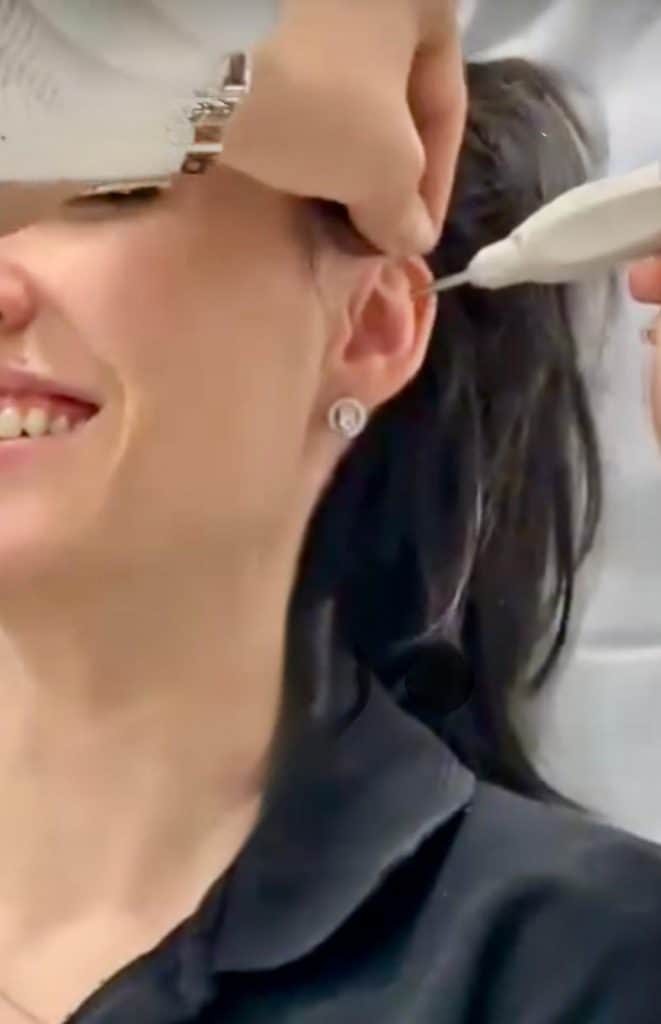
Electroacupuncture with a portable electrostimulator for auricular acupuncture
Direct application of bioelectric principles
Technology through an electronic acupuncture balancing system is practically a direct clinical application of the concepts described previously. Based on the fact that active points have low electrical resistance, the device allows:
🔹 Objective point detection
Using special electrodes, the device identifies:
- points with increased conductivity
- active reflex zones
- correlations with internal dysfunctions
👉 precisely as described in INSERM research: stable points with low electrical resistance, very small in size (~1 mm²). .
🔹 Therapeutic stimulation
After identification, the points are stimulated, causing:
- neurological reflex activation
- functional regulation of organs
- pain relief
This is not simple stimulation, but a guided bioelectric intervention.
Point stimulation can be done electrically by attaching tiny, non-invasive devices called Vaccaria seeds or very small and fine dedicated needles called ASPs.
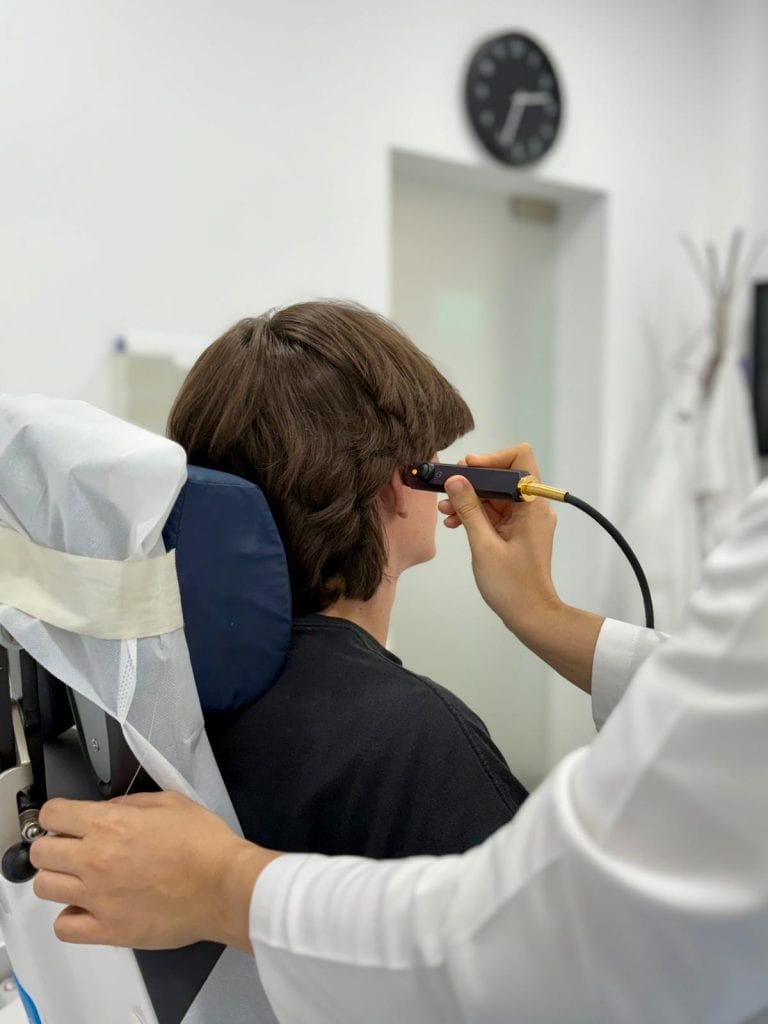
THOR Laser Auriculotherapy
Expansion neuromodulation at the cellular level
Therapeutic laser provides an additional level of action compared to electrical stimulation. If the electronic acupuncture balancing system acts predominantly through reflex and bioelectrical mechanisms, the laser adds:
- direct biological effects on tissues
- mitochondrial stimulation
- reducing inflammation
The laser does not contradict auricular theory, but rather complements it:
- ear point → bioelectrically detected
- stimulation → performed without pain
- cellular level response
Thus, auriculotherapy becomes a combination of neurological reflex and tissue biostimulation.
Why does auriculotherapy work?
From the integrated perspective of TCM and modern medicine, effectiveness is based on three pillars:
- Neurologic reflex
Signal transmission to the CNS and organs
- Bioelectricity
Detection and modulation of active points
- Functional projection
Reflection of the state of the organs in the ear
This combination explains why the ear is considered one of the most sensitive organs for diagnosis and treatment.
Auriculotherapy is not just a traditional technique reinterpreted in modern times. It is a complex medical method, supported by:
- Somatotopic mapping
- neurological reflexes demonstrated
- measurable bioelectric mechanisms
By integrating modern technologies such as the portable auriculotherapy electrostimulator and THOR laser, this method achieves a level of precision and efficiency comparable to neuromodulation therapies used internationally, while combining thousands of years of TCM knowledge. Through this vision, auriculotherapy is not just a technique, but an expression of how TCM understands body: as an integrated system, where each part reflects the whole.
How is the treatment carried out
Auriculotherapy is a simple, well-tolerated procedure, adapted to each individual patient.
The session begins with a clinical evaluation, during which symptoms and functional imbalances are identified. Subsequently, the doctor identifies active ear points using detection technology.
Stimulating these points can be achieved through:
- controlled electrical impulses
- low-level therapeutic laser
- application of ear seeds for a prolonged effect
- application of dedicated needles for auriculotherapy
The treatment generally lasts between 20 and 40 minutes and does not require recovery.
What does the patient feel during therapy
Auriculotherapy is a minimally invasive and, in most cases, painless procedure. During the session, the patient may feel:
- a slight feeling of warmth or tingling
- discrete pressure at certain points
- A progressive state of relaxation
In the case of laser stimulation or electrical stimulation, the sensations are minimal or absent, making the method ideal for sensitive patients.
What the patient feels after treatment
After the meeting, most patients describe:
- a reduction in muscle tension
- A state of calm and relaxation
- pain relief
- Better mental clarity
In the case of chronic conditions, the effects appear progressively, from one session to the next.
🔷 Classification of conditions treatable by auriculotherapy
Ear this is a complete microsystem → you can influence any bodily function.
🔶 1. Physical conditions – musculoskeletal system and pain
Auriculotherapy is frequently used for pain treatment, this being one of the first clinically validated areas. It can be used to treat:
- Muscle and myofascial pain
- Low back pain, neck pain
- Shoulder, TMJ, knee, ankle, etc. joint pain
- Postural pain
- Muscle cramps
🔶 2. Functional disorders of internal organsZang-Fu)
Based on projection theory, each internal organ has an auricular representation. Examples from the logic of the points described in the book:
- Digestive system → gastritis, bloating, bowel movement disorders
- respiratory system → impaired breathing, chest tightness, COPD
- cardiovascular system → functional regulation
- renal system → energy balance
Changes in internal organs are reflected in the ear and can be influenced through stimulation.
🔶 3. Endocrine system and hormonal regulation
An extremely important aspect of the book is the representation auricular hormonal points.These points influence:
- fertility
- menstrual cycle
- metabolism
- response to stress
- Global endocrine function
- metabolic disorders
🔶 4. Nervous System and Neurovegetative Imbalances
The ear is richly innervated, and one of the main bases for therapy is the neurological reflex. Stimulation of auricular points causes:
- autonomic nervous system regulation
- sympathetic-parasympathetic system balancing
- Reducing hyperresponsiveness
Can be treated:
- anxiety
- chronic stress
- insomnia
- Nervous exhaustion
- brain fog
🔶 5. Psychosomatic conditions
Auriculotherapy is extremely effective for conditions where emotion is transformed into physical symptoms. These include:
- bruxism
- chronic muscle tension
- pains without a clear structural cause
- functional digestive disorders
🔶 Psychic and Emotional Component
In TCM, organs are directly associated with emotions:
- liver → anger, tension, frustration
- splenetic, irritable → grumble, worry
- kidney → fear
- heart → anxiety
Therefore, stimulating ear points can influence:
- emotional state
- anxiety level
- relaxation capacity
- sleep quality
👉 Auriculotherapy thus becomes a method of psycho-emotional regulation, not just physical. Due to the fact that the ear is a complete microsystem, it allows intervention on:
- the physical body
- internal organs
- nervous system
- hormonal system
- emotional state
Schedule an evaluation
If you recognize yourself in the described symptoms — pain, anxiety, bruxism, insomnia, functional digestive disorders, or a feeling of imbalance — it's time to understand the real cause, not just treat the effects. At Expert Laser Center, auriculotherapy is integrated into a complete medical evaluation, tailored to each patient, using modern technologies and a multidisciplinary approach based on ancient Chinese medicine.
👉 Schedule a consultation now and discover how we can regulate your nervous system and restore your body's balance, in an effective, minimally invasive, and personalized way.

 Romanian
 English