
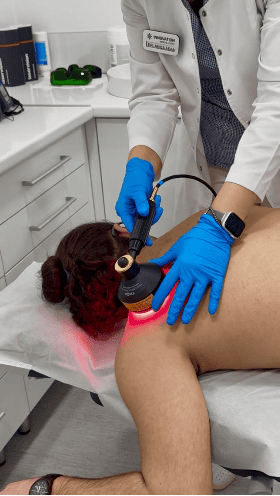
When back or knee pain appears, tendinitis, osteoarthritis, or a muscle injury, the natural question is: „Where does it hurt?”
Research in recent years in the field of photobiomodulation (low-level light therapy, also known as PBM) also brings a second, complementary question: „What does the body need to recover?”
More and more studies show that healing does not depend exclusively on the affected area, but also on The body's general biological response.
Local treatment remains the basis of recovery. For conditions such as:
- painful joints
tendonitis
- muscle injuries
osteoarthritis
- neuropathies
- local inflammation
Photobiomodulation is applied directly to the affected tissue. This is and remains the foundation of any recovery protocol.
Published research supports the effects of PBM on:
- of pain
– of inflammation
– of the microcirculation
- of tissue regeneration
– functional recovery
The body always heals as a whole. Beyond the joint, the healing process involves:
– the vascular system
– cellular metabolism
– the inflammatory response
– the nervous system
– the regenerative mechanisms
- the body's adaptability
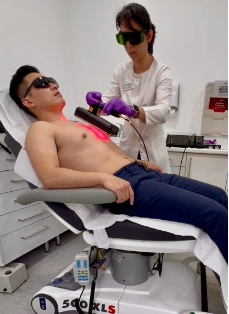
That is why, in certain selected clinical situations, researchers are also exploring the concept of Systemic photobiomodulation — a new direction, which does not replace local treatment, but complements it.
What is systemic photobiomodulation?
It means using therapeutic light on anatomical areas (such as the sternum, tibia, or regions rich in bone marrow) with the goal of influencing broader biological responses of the body—not to directly treat a joint, but to supports the general processes involved in recovery. It is applied selectively, on a case-by-case basis, at the doctor's recommendation.
What do the studies say, specifically?
A laboratory study on bone marrow stem cells from aged mice (Eroglu et al., 2021) showed that PBM can improve mitochondrial function and some cellular aging markers. It suggests a plausible biological mechanism behind the clinically observed effects.
🔗 Nature
A small pilot clinical study in patients with myocardial infarction (Elbaz-Greener et al., 2018) tested the application of PBM to the tibia and reported possible biological effects at a distance from the directly treated area. Being a pilot study, the results are promising but require confirmation in larger studies.
🔗 PubMed
These results transform photobiomodulation into a stem cell modulating therapy. However, they show that the organism can respond to light beyond the treated area — a scientific basis for the direction we are exploring.
An integrated approach, not a promise
The Expert Laser Center, The treatment of an injury is not always limited to the painful area. In selected cases, the local protocol can be supplemented with:
– local treatment of the affected tissue
- regional photobiomodulation
– systemic applications (where indicated)
The decision to use systemic protocols is made individually by the doctor, depending on the condition, medical history, and recovery goals.
The technology we use
We use THOR equipment, one of the photobiomodulation systems with the longest-running clinical research activity in the field, recognized for his contribution to the development evidence-based medicine in the field of light therapy.
THOR systems are used in the clinical and research activities of internationally renowned academic and medical institutions such as Harvard Medical School, Massachusetts Institute of Technology (MIT), University of Pennsylvania, and New York University., alongside military organizations from the US and Great Britain, Olympic teams, elite athletes, and leading medical centers worldwide.
For us, choosing equipment is not just a technical decision, but a commitment to scientific rigor and patient safety.
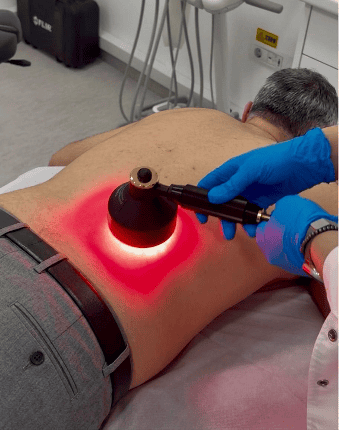
Modern recovery isn't just about treating a joint or muscle. It's about viewing the body as a complex biological system, in which local and—in selected cases—systemic processes can work together to support healing.
Photobiomodulation remains, first and foremost, a local treatment with a solid scientific basis. The systemic component is a promising research direction, which we apply cautiously and only when clinically indicated.
Expert Laser Center this associated center and European partner of Sigmund Freud University Vienna and and AALZ Aachen, being affiliated ISLD International Society for Laser Dentistry.
These academic collaborations guarantee the application of clinical protocols aligned with the highest international scientific standardsn therapy laser complex. The center uses medical infrastructure to 2026 standards and has a medical team specialized in functional assessment and integrated treatment.
Schedule an assessment at a center specializing in laser therapies and integrated medicine!
Frequently Asked Questions
No. When indicated, it is a complement to the local protocol, not a substitute.
No. Photobiomodulation is non-invasive and generally does not cause discomfort.
It is decided individually, after medical evaluation, depending on the condition and response to local treatment.
📍 Expert Laser Center – Bucharest
🌐 Website https://expertlaser.ro
📞 Telephone +40 790 673 866
Author: Dr. Anca Adam
Specialist in Physical Medicine and Rehabilitation, neurological recovery compartment, Competence in Traditional Chinese Medicine (Tai Yuan China), Expert in Laser Acupuncture & Medical Thermography (Barcelona, Spain) – LSO (Laser Safety Officer) AALZ Aachen Germany

 Romanian
 English