
ASP Classic, electrical stimulation, or laser: what we know in 2026 about auricular point stimulation
„Every autumn it starts all over again.”
This is how many patients describe the period when repeated sneezing, a runny or stuffy nose, nasal itching, tearing, and irritated eyes reappear. For anyone experiencing these symptoms every year, the beginning of autumn can mean more than just a change in weather: it can mean the return of seasonal allergic rhinitis.
One of the questions I get is whether auriculotherapy can help.
The short answer is: it can be considered as a complementary approach in some patients, but it does not replace allergological treatment. There are studies and meta-analyses suggesting that certain forms of auricular stimulation can alleviate some symptoms of allergic rhinitis.
In my practice, auricular points can be stimulated in several ways: with ASP Classic semi-permanent ear needles, through electrical stimulation, or with a laser, without needles. However, the choice does not start with the device, but with the patient, the diagnosis, and the realistic objective of a complementary therapy.
What does „autumn allergy” mean?
Allergic rhinitis is an inflammatory condition of the nasal mucosa that occurs when a sensitized person comes into contact with an allergen. Among the best-known allergens are pollens, but symptoms can also be associated with dust mites, molds, animal dander, or other environmental factors.
For the patient, the clinical picture is usually easy to recognize:
- I sneeze in salvos
- Watery nasal secretions
- Stuffy nose
- Itchy nose
- Tearing, redness, or eye itching
- Sometimes, fatigue, disturbed sleep, and difficulty concentrating
„Autumn allergy” is not a single diagnosis. The duration of symptoms and the allergens involved differ from person to person. If symptoms appear for the first time, are intense, persistent, affect sleep or daily activity, or if the diagnosis is uncertain, an allergological and, where applicable, ENT evaluation remains important.
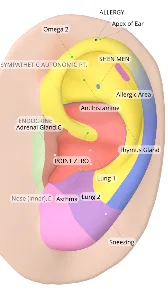
Where can auriculotherapy intervene?
Auriculotherapy uses certain areas of the auricle as stimulation points. It can be classified as complementary medicine, not as a replacement for allergy treatment.
It is important to avoid two simplifications from the start:
- There is no „universal recipe” of points for every person with an allergy
- Not all auricular stimulation methods are clinically equivalent
The evaluation includes the patient's symptoms, the already established diagnosis or clinical suspicion, current treatments, tolerance to the procedure, and the therapeutic goal. Only then can the stimulation modality be chosen.
Depending on the case, auricular points can be stimulated using semi-permanent auricular needles, by electrical stimulation performed during the session, or by laser stimulation, without needle insertion and without pain.
Classic ASP: Extended stimulation
ASP Classic is a semi-permanent, sterile, and single-use auricular needle designed for temporary application to the auricle. After identifying the point, the needle is applied locally and can be maintained for a limited period, according to clinical indication and device instructions.
The practical feature of this method is that the stimulation can continue even after the consultation ends.
This option may be suitable for patients who accept the temporary presence of an auricular needle, want stimulation that continues between sessions, have no contraindications to this approach, and understand the care rules and the signs for which they need to contact the therapist.
Classic ASP is not mandatory for every patient. Some patients prefer exclusively in-office stimulation, and others do not want needles at all.
Auricular electrical stimulation
Electrical stimulation involves identifying the points and applying controlled stimulation with equipment intended for this purpose during the session. After the procedure, no semi-permanent needle remains in the auricle.
This option can be useful when the patient does not wish to keep auricular needles between sessions, when we prefer stimulation to take place only in the clinic, or when there are practical reasons to avoid a semi-permanent device.
The fact that the stimulation is electrical does not automatically mean it is more efficient than ASP or the laser for allergic rhinitis. Currently, there are not enough robust comparative data to allow a simple hierarchy among these three modalities.
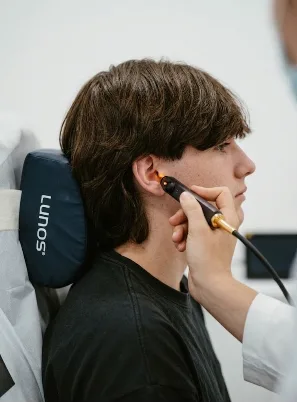
Auricular laser: needle-free stimulation
The laser allows for the non-invasive stimulation of auricular points. It does not involve the insertion of a needle and no device remains in the ear after the session.
For patients who are afraid of needles, have increased sensitivity to invasive procedures, or prefer a needle-free approach, this can represent an important practical advantage.
ASP, electric or laser?
The question „which one is better?” seems natural, but it is too simple for the current level of evidence.
Method | How to apply | Practical feature |
Classic ASP | Semi-permanent needle applied to the auricular point | Stimulation can continue between consultations |
Electrical stimulation | Controlled stimulation during the session | There is no needle left after the procedure |
Ear laser | Non-invasive, needle-free stimulation | Option for people who don't want needles |
The choice may depend on the clinical evaluation, symptoms and diagnosis of the patient, the selected points, needle tolerance, local sensitivity, the pursued objective, informed preferences, and potential contraindications or precautions.
What does the research say?
The available evidence is interesting, but it must be read with care.
A 2021 systematic review and meta-analysis included 11 randomized studies with 1,094 participants regarding auricular acupressure for allergic rhinitis. The authors reported favorable results for some measures of nasal symptoms, sneezing, ocular symptoms, and quality of life. However, their conclusion was cautious: despite the positive results, it was premature to confirm the effectiveness of auricular acupressure, as more rigorous studies regarding efficacy and safety are needed.
A meta-analysis published in 2024 included 15 studies and 1,002 patients. The authors reported that auricular interventions used as an adjunct were associated with better outcomes than control for symptoms such as nasal congestion, rhinorrhea, nasal pruritus, and sneezing.
These results justify the interest in research, but do not allow for excessive conclusions. The studies differ in the type of auricular intervention, the points used, the duration of treatment, the association with conventional treatments, the chosen comparators, the symptom assessment methods, and the methodological quality.
Does auriculotherapy replace antihistamines?
No.
The treatment of allergic rhinitis is determined based on the type and severity of symptoms, the impact on the patient's life, preferences, response to previous therapies, and the presence of other conditions.
The updated ARIA-EAACI guidelines keep evidence-based intranasal treatments at the center of the pharmacological management of allergic rhinitis. Depending on the patient, the regimen may include intranasal corticosteroids, intranasal or oral antihistamines, and intranasal combinations when indicated. In selected patients, following an allergy evaluation, allergen-specific immunotherapy may also be considered.
If the patient is following a treatment prescribed by an allergist or ENT specialist, I do not recommend stopping or modifying it based on auriculotherapy. Any change to the therapeutic regimen must be discussed with the physician managing the allergy.
How do we approach auriculotherapy at Expert Laser Center?
The consultation does not start with the question „IPL or laser?”. It starts with the patient.
I am interested in what symptoms are present and how much they affect daily activity, when they occur and if there is a clear seasonal link, if there is an established allergological diagnosis, what treatments are already used, whether the symptoms are controlled, what the patient expects from a complementary approach, and whether or not they prefer a needle-based method.
Only after that follows the specific evaluation and selection of auricular points. The chosen method must be adapted to the patient, not the other way around.
Within Expert Laser Center, classic ASP, auricular electrical stimulation, and non-invasive laser stimulation can be used. The value of having multiple options is not the number of devices, but the ability to choose a method proportional to the clinical situation, tolerance, and patient preferences.
When should medical help be requested?
Auriculotherapy must not delay the diagnosis or treatment of a problem that requires medical evaluation. Schedule an allergology or ENT evaluation if:
- Symptoms appear for the first time and the diagnosis is not clear
- The symptoms are severe or persistent
- Sleep, work, school, or daily activities are affected
- Usual treatment does not control symptoms
- Repeated sinusitis, decreased sense of smell, frequent epistaxis, or significant facial symptoms
- There is a cough, wheezing, shortness of breath, or suspicion of asthma
- Generalized allergic reactions, swelling of the face or tongue, or breathing difficulties appear
In case of respiratory difficulty, rapid swelling of the face, tongue, or throat, feeling of suffocation, significant dizziness, or a generalized allergic reaction, emergency medical evaluation is required.
Myth or medicine?
„Auriculotherapy cures allergies.” We have no evidence for this claim. There is research regarding the alleviation of some symptoms, but auriculotherapy does not demonstrably eliminate allergic sensitization and should not be presented as a curative treatment.
„If acupuncture works, laser therapy on the same points automatically works too.” No. The method of stimulation matters. The results obtained for one intervention cannot be automatically transferred to another.
„If done auriculotherapy, can I stop the anti-allergy treatment.” No. The prescribed treatment must not be interrupted without the recommendation of the managing physician.
„The same points are used for all allergy patients.” No. Symptoms, diagnosis, existing treatments, patient preferences, and the stimulation method must be evaluated individually.
Frequently Asked Questions
Studies suggest there are benefits of certain forms of acupressure or auricular stimulation on certain symptoms of allergic rhinitis. However, the certainty of the evidence remains limited. Auriculotherapy can be discussed as a complementary approach, not as a replacement for allergy treatment.
ASP Classic is a semi-permanent, sterile, and single-use auricular needle designed for the temporary and prolonged stimulation of an auricular point.
The insertion involves the use of a needle and may produce short-term local discomfort. Sensitivity varies from person to person. For patients who do not want needles, there may be needle-free stimulation methods.
Yes. Depending on the indication and evaluation, auricular points can be stimulated electrically or with a laser.
Not based on auriculotherapy and not without the recommendation of the doctor managing the allergy. Standard treatment and complementary therapy can have different roles.
There is no universal number of sessions proven to be optimal for classic acupuncture, electrical stimulation, and auricular laser in allergic rhinitis. The protocol depends on the chosen method, patient evaluation, the pursued objective, and the clinical response.
Not automatically. Before the procedure, the medical history, diagnosis, existing treatments, patient preferences, the condition of the auricle, and the chosen stimulation method must be analyzed.
Medical sources and recommended reading
- Zhong J, Liu S, Lai D, et al. Ear Acupressure for Allergic Rhinitis: A Systematic Review and Meta-Analysis of Randomized Controlled Trials. Evid Based Complement Alternat Med. 2021;2021:6699749. PMID: 34007299.
- Cheng S, et al. The combined application of ear acupuncture in the treatment of allergic rhinitis: A meta-analysis. Heliyon. 2024;10(4):e25181. PMID: 38370208.
- Du SH, et al. Clinical practice guideline for acupuncture and moxibustion: Allergic rhinitis. J Integr Med. 2024;22(3):245-257. PMID: 38616445.
- ARIA-EAACI. Allergic Rhinitis and Its Impact on Asthma: 2024-2025 Revision, Part I – Guidelines on Intranasal Treatments.
📍 Expert Laser Center – Bucharest
🌐 Website https://expertlaser.ro
📞 Telephone +40753666111
Author: Dr. Anca Adam
Specialist in Physical Medicine and Rehabilitation, neurological recovery compartment, Competence in Traditional Chinese Medicine (Tai Yuan China), Expert in Laser Acupuncture & Medical Thermography (Barcelona, Spain) – LSO (Laser Safety Officer) AALZ Aachen Germany

 Romanian
 English