
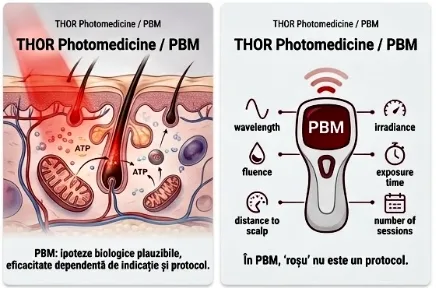
There is no single treatment that suits everyone who experiences hair loss. Medication has a well-established role in alopecia androgenetic, and photobiomodulation also has favorable evidence for this condition. Sometimes they can be associated. However, if the cause is different, the treatment must be changed along with the diagnosis.
„I want something natural.” „I don't want medications.” „I don't want injections.” „I've already tried minoxidil.” „Can I just do laser?”
These are natural questions. But before choosing between minoxidil, red light, supplements, or any other intervention, there is a more important question:
What are we treating?
Hair loss is a symptom
Androgenetic alopecia is different from telogen effluvium. Alopecia areata is different from both. And a cicatricial alopecia can have completely different implications. That is why the treatment that a friend used successfully or that we see in a 30-second clip is not automatically right for us.
When the cause is unclear or there are signs raising the suspicion of a dermatological pathology, dermatological evaluation takes priority.
Minoxidil or red light?
They do not necessarily have to be viewed as two opposing camps. Topical minoxidil is an established treatment for androgenetic alopecia. LLLT/PBM represents a non-invasive option for which there is also favorable clinical evidence in this condition.
The more interesting question is whether combining the two offers an advantage. And here, the literature gives us a very good example of why medicine should not be presented in black and white.
What do studies say about the association of minoxidil + laser?
A meta-analysis published in 2025, based on four eligible studies, found no statistically significant difference in hair count or hair diameter between minoxidil alone and the combination of minoxidil + LLLT. https://pubmed.ncbi.nlm.nih.gov/39828269/
Another 2025 meta-analysis, which included randomized trials and used a more recent literature search, evaluated the same association and reported favorable results for the combination regarding certain hair growth outcomes. https://pubmed.ncbi.nlm.nih.gov/40826200/
And the broader meta-analysis published in 2026 found for LLLT + minoxidil an improvement in density of 11,75 cal/cm² compared to minoxidil alone. https://pubmed.ncbi.nlm.nih.gov/42339398/
What do we do when two analyses don't say the exact same thing?
We tell the patient the truth: There are arguments for the combination, but the magnitude of the additional benefit and the patients who benefit most from the combination still require study.
Can I choose a non-medication option?
In certain cases, PBM may be considered as a non-pharmacological option. However, „drug-free” treatment should not become a goal that takes precedence over proper treatment.
If a patient has a condition that requires drug treatment, the fact that they prefer something „natural” does not change the biology of the disease. However, if there are several reasonable options and the patient prefers a non-invasive intervention, this preference may be factored into the treatment decision.
That is, in fact, what personalized care means: We don't just focus on the diagnosis, nor do we focus solely on the patient's preference; we try to balance the two appropriately.
What happens if hair falls out from stress?
Telogen effluvium is one of the conditions in which a patient may experience significant diffuse hair loss following a stressful event. Sometimes, the cause of that event is obvious. Other times, the connection isn’t immediately made, precisely because hair loss can occur some time after the triggering factor.
Data for PBM in telogen effluvium are still limited. The 2024 retrospective study on 140 patients with post-COVID telogen effluvium reported more favorable results after 12 weeks in the groups receiving LED compared to untreated ones, including in terms of halting hair loss and certain trichoscopic parameters. https://pubmed.ncbi.nlm.nih.gov/38940108/
This is enough to consider the field interesting. It is not enough to promise the same result to every patient with „hair loss from stress.”.
What about alopecia areata?
Alopecia areata is an immunological condition that requires proper medical evaluation and management. PBM should not be presented as a replacement for treatments indicated by a dermatologist, but as an adjuvant treatment.
What about laser acupuncture?
At Expert Laser Center, integration is also possible laser acupuncture, performed without needles, within an approach based on the principles of Traditional Chinese Medicine.
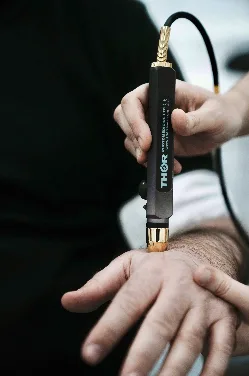
Laser acupuncture can be part of an individualized complementary approach, based on the Chinese medicine diagnosis of each patient. Thus, through the complex integration of the two treatment directions, the patient benefits from a systemic, yet targeted approach to the scalp.
Why can „needle-free” still be important?
For some patients, it matters a great deal. PBM does not involve scalp injections, repeated trauma to it, or the local administration of a substance. From this perspective, it is an intervention non-invasive and needle-free.
But this must be a practical advantage, not the main argument for effectiveness. The treatment is not good because „it has no needles.” It is good when there is an indication and reasonable evidence that it can help with that issue.
How do we choose the treatment at Expert Laser Center?
We start from the hair loss pattern, onset, evolution, triggering events, previous treatments, and other clinically relevant elements. Depending on the situation, a dermatological evaluation and/or investigation of associated factors may be necessary before establishing the plan.
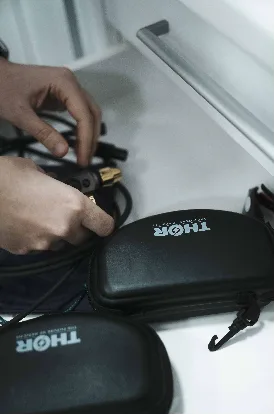
If there is an indication for PBM, we use professional THOR Photomedicine technology within a protocol adapted to the clinical situation. In other cases, photobiomodulation may be only part of the strategy.
Personalized treatment does not mean giving every patient a more complex combination. Sometimes it means the exact opposite: using only what makes sense for them.
Frequently Asked Questions
There is no one-size-fits-all answer. Both are effective for androgenetic alopecia, and the choice depends on the diagnosis, the patient's profile, and the treatment plan.
Yes, the association has been studied. Some meta-analyses report an additional benefit, while an analysis based on four studies found no significant difference.
Yes. PBM is a non-invasive intervention and does not involve injections.
In some situations, PBM without pharmacological treatment can be considered; in others, it is not enough. The diagnosis decides.
Many cases of telogen effluvium can improve after the removal or resolution of the triggering factor, but the progression must be interpreted in a clinical context. PBM is being studied as a possible adjuvant.
No. Scalp PBM and laser acupuncture point stimulation are different interventions and have different evidence bases.
Not automatically. The natural origin or absence of a drug does not guarantee the effectiveness or safety of an intervention. We prefer the terms non-invasive and non-pharmacological when they correctly describe the treatment.
Let's try to find out why. A treatment chosen before diagnosis can consume months without resolving the cause.
When dealing with hair loss, there is a temptation to look for a single solution: a medication, a supplement, a procedure, or a light.
Biology is, however, more complicated.
In alopecia androgenetic, PBM currently has real-world clinical evidence and can represent a non-invasive option or a component of treatment. For other forms of alopecia, the level of evidence differs, and this must be stated openly.
At Expert Laser Center, the goal is not to apply the same technology to all patients, but to use technology when the diagnosis and medical data justify its use.
Sometimes the solution may include light. Other times, no. The quality of treatment begins precisely by knowing the difference.
📍 Expert Laser Center – Bucharest
🌐 Website https://expertlaser.ro
📞 Telephone +40753666111
Author: Dr. Anca Adam
Specialist in Physical Medicine and Rehabilitation, neurological recovery compartment, Competence in Traditional Chinese Medicine (Tai Yuan China), Expert in Laser Acupuncture & Medical Thermography (Barcelona, Spain) – LSO (Laser Safety Officer) AALZ Aachen Germany

 Romanian
 English