
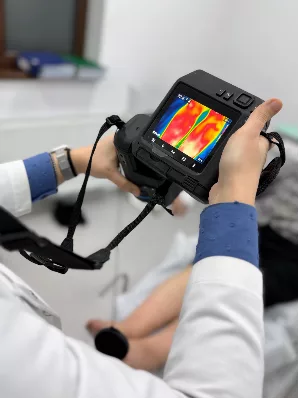
Photobiomodulation in delayed-healing wounds — from cellular mechanisms to a clinical case, Expert Laser Center
„The surgery went well. Then why is the wound still not closing?“
I've heard this question many times. And every time I realize how counterintuitive it is for patients: the procedure is over, the main problem has been solved, but somewhere, a small area of the wound remains open and exudative. In an elderly, frail patient, after major surgery and in an oncological context, things get even more complicated.
Healing doesn't happen just because „enough time has passed.” It's an active biological process — it needs cellular energy, vascularization, inflammation control, migrating keratinocytes, working fibroblasts, reorganizing collagen, and an immune system that knows when to turn off the alarm. When one of these stages gets stuck, the whole process slows down.
This is where photobiomodulation (PBM) comes in.
A plague is, in fact, a construction site
I often explain it to patients like this: a wound is like a construction site after a serious breakdown. First, the debris must be cleared. Then materials are brought in, new vessels are raised, the collagen „scaffolding” is rebuilt, and only at the end is the surface covered with a functional layer of cells.
If workers are few, if materials arrive with difficulty, or if the construction site remains stuck in a permanent state of alert, reconstruction slows down. The same thing happens in a wound with delayed healing. Age, nutritional status, diabetes, vascular diseases, infection, certain treatments, systemic inflammation, oncological diseases — all can slow down the rate at which the body repairs tissue.
What can light do here
PBM uses non-ionizing light, usually red and near-infrared, at parameters designed to produce photophysical and photochemical effects without thermally heating the tissue. Research on PBM mechanisms discusses mitochondrial metabolism, ATP, nitric oxide, signaling reactive oxygen species, and several molecular pathways involved in inflammation and regeneration.
However, wound healing is not limited to ATP. Preclinical and clinical studies describe potential effects on fibroblasts, keratinocytes, angiogenesis, extracellular matrix remodeling, and the macrophage response—including, in more recent data, the modulation of the macrophage phenotype, one of the mechanisms by which a wound transitions from the inflammatory to the repair phase.
What the studies show
- Literature from the last two years has become much more interesting. A 2024 meta-analysis on skin wounds looked at the effects of low-level laser therapy on healing and pain — overall favorable results, but with high heterogeneity between protocols and wound types.
Taha N, Daoud H, Malik T, et al. The Effects of Low-Level Laser Therapy on Wound Healing and Pain Management in Skin WoundsA Systematic Review and Meta-Analysis. Cureus, 2024 Oct 28.
🔗 https://pubmed.ncbi.nlm.nih.gov/39610644/
- A 2024 randomized clinical trial on diabetic foot ulcers showed a trend toward a more rapid reduction in ulcer surface area in the group treated with red and infrared lasers, compared to the control group—with the effect being more pronounced for infrared in that particular protocol.
Borges NCS, Soares LR, Perissini MM, et al. Photobiomodulation using red and infrared spectrum light light-emitting diode (LED) for the healing of diabetic foot ulcers: a controlled randomized clinical trial. Lasers Med Sci, 2024 Oct 9.
🔗 https://pubmed.ncbi.nlm.nih.gov/39382587/
- In 2025, new data emerged on hard-to-heal and surgical wounds, and in 2026 a randomized trial reported better healing at 7 days and less discomfort after tooth extractions in the group treated with PBM compared to placebo. It is not the same clinical situation as an abdominal wound, obviously, but it reinforces the idea that the postoperative tissue response to light deserves serious investigation.
Salem RE, Bakry NS, Soliman RS. Effect of photobiomodulation therapy on wound healing and post-extraction pain management of primary molars: a randomized controlled clinical trial. BMC Oral Health, 2026 Jul 15.
🔗 https://pubmed.ncbi.nlm.nih.gov/42458386/
And, to be completely fair: not all studies are positive. A recent meta-analysis on burns found no significant benefits for some of the analyzed outcomes. Exactly these differences show why diagnosis, patient selection, and dosimetry matter so much — not the „laser” itself.
A case that stuck in my mind
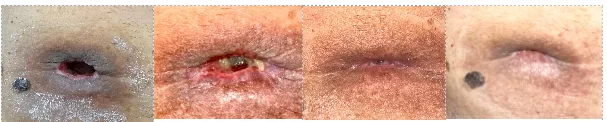
An 80-year-old patient, operated on for a colonic adenocarcinoma — right hemicolectomy, with closure of a pre-existing ileostomy. The main abdominal wound progressed well, but the area of the former ileostomy had delayed healing: partial reopening, minimal exudate, local pain.
It was not a simple context. Elderly patient, major abdominal surgery, oncological pathology, fragile biological status — exactly the kind of situation where the body's ability to repair itself can be slowed down.
I introduced photobiomodulation as an adjuvant therapy — not in place of surgical wound care. Local debridement, dressings, and monitoring continued exactly as decided by the treating team. I worked with THOR Photomedicine technology, following a phased protocol: an initial more intensive period, followed by increasingly spaced-out sessions, adapted to the tissue's evolution.
In the first weeks, the pain and exudate progressively decreased, and the wound bed looked better and better—the opening visibly reduced from one session to another. Serial clinical photographs documented the approximation of the margins and the epithelialization of the area. At the end of the treatment period, the region of the former stoma had intact skin, without active secretion, with the appearance of a maturing scar.
The result is nice, but the scientifically correct phrasing is: healing occurred during the period when PBM was associated with standard care, and the evolution over time is compatible with a favorable adjuvant effect.
Chronological evolution of the lesion
What about the cancer patient?
It is a question I ask myself every time. PBM already has a well-established role in certain forms of supportive oncological care — the most solid example being the prevention and management of oral mucositis, within certain oncological treatment protocols. Recent literature increasingly analyzes the benefits of PBM in the oncological patient in general.
In a cancer patient, the treatment location, oncological status, and benefit-risk ratio must be evaluated individually and coordinated with the oncology team when relevant. In the case above, the goal of therapy was strictly the post-ileostomy surgical wound, as part of postoperative recovery — not the oncological disease itself.
Why THOR, with us
In a field where the dose matters so much, it is not merely the fact that „there is a laser in the clinic” that makes the difference. What matters is the wavelength, the power, the total energy, the treated area, the frequency of the sessions, the biological stage of the wound — and how all of these are integrated into the patient's overall care.
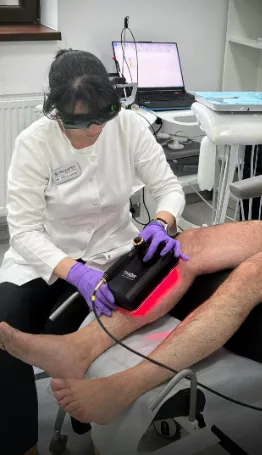
At Expert Laser Center, we use THOR Photomedicine systems, specifically developed for photobiomodulation and clinical protocols for professionals. THOR also publishes resources dedicated to wound healing and the use of PBM as an adjuvant for pain management and tissue repair.
For larger anatomical surfaces, Giant Laser Cluster technology allows the treatment of an extensive area with a controlled energy distribution; smaller applicators allow a focal approach, but the device remains only a tool. The result depends on the protocol, the indication, and the physician who knows exactly what they want to achieve biologically.
Myth or reality?
„The laser closes the wound.“ — Myth. PBM does not „glue” tissue. The body produces granulation, collagen, and epithelization; light can support some of the processes, it does not replace them.
„With greater power, the wound heals faster.“ — Myth. PBM has a dose-dependent response. More doesn't automatically mean better — the literature shows high variability between protocols.
„PBM replaces dressings and infection treatment.“ — Myth. It is an adjuvant therapy. Infection control, exudate management, vascularity, nutrition, and proper wound care remain fundamental.
„PBM is only for pain.“ — Myth. Analgesia is just one application among many researched. There is consistent literature on tissue repair mechanisms, although the level of evidence varies greatly from one indication to another.
Frequently asked questions
Can laser therapy be used for any non-healing wound?
No. First, it must be identified why the wound is not healing: infection, ischemia, uncontrolled diabetes, persistent pressure, nutritional deficiency, deep surgical dehiscence, or other causes that require specific treatment.
Can PBM be applied to an infected wound?
A suspected wound infection must be medically evaluated and treated according to wound care standards. PBM does not replace antibiotic therapy or drainage when indicated.
How many sessions are needed?
There is no universal figure. It depends on the etiology of the wound, size, depth, healing phase, comorbidities, and the protocol used.
It is safe photobiomodulation in the cancer patient?
There are oncological indications for supportive care for which PBM is well-studied, but its use in cancer patients must be individualized on a case-by-case basis.
A healing wound is, I believe, one of the most beautiful images in regenerative medicine. I don't just see „a closing wound” — I see cells migrating, vessels forming, collagen reorganizing, an entire biological system trying to rebuild what was lost. Photobiomodulation doesn't replace this biology. It simply comes to support it.
📍 Expert Laser Center – Bucharest
🌐 Website https://expertlaser.ro
📞 Telephone +40753666111
Author: Dr. Anca Adam
Specialist in Physical Medicine and Rehabilitation, neurological recovery compartment, Competence in Traditional Chinese Medicine (Tai Yuan China), Expert in Laser Acupuncture & Medical Thermography (Barcelona, Spain) – LSO (Laser Safety Officer) AALZ Aachen Germany

 Romanian
 English